How Long Is the Cable Car Ride to the Big Buddha?
The Ngong Ping cable car takes about 25 minutes each way over 5.7 km, but the real question is total time. Here is the honest hour-by-hour budget for the Big Buddha day.
How Long Is the Cable Car Ride to the Big Buddha?
The cable car ride to the Big Buddha takes about 25 minutes each way, covering 5.7 km from Tung Chung to the Ngong Ping plateau, in a fleet of 108 cabins that leave continuously rather than to a fixed timetable. There is no faster leg and no slower leg: both directions run the same route over Tung Chung Bay, the airport and the country park.
That 25 minutes is the honest headline, and it is verified on the operator's own pages. But it answers a narrower question than most visitors are actually asking. The Big Buddha sits about 10 minutes on foot from the Ngong Ping terminal, up 268 steps, and the cable car queue at Tung Chung can be longer than the ride itself. If you are planning the day around a flight, a Disneyland afternoon or a dinner back in Central, the number you need is the total door-to-door time, not the airborne time.
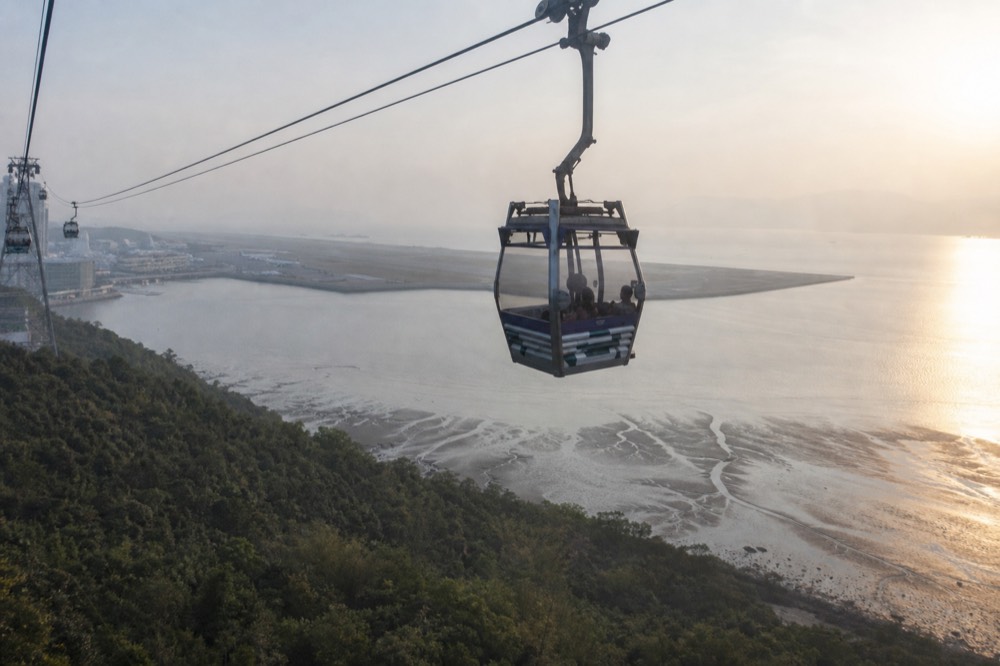
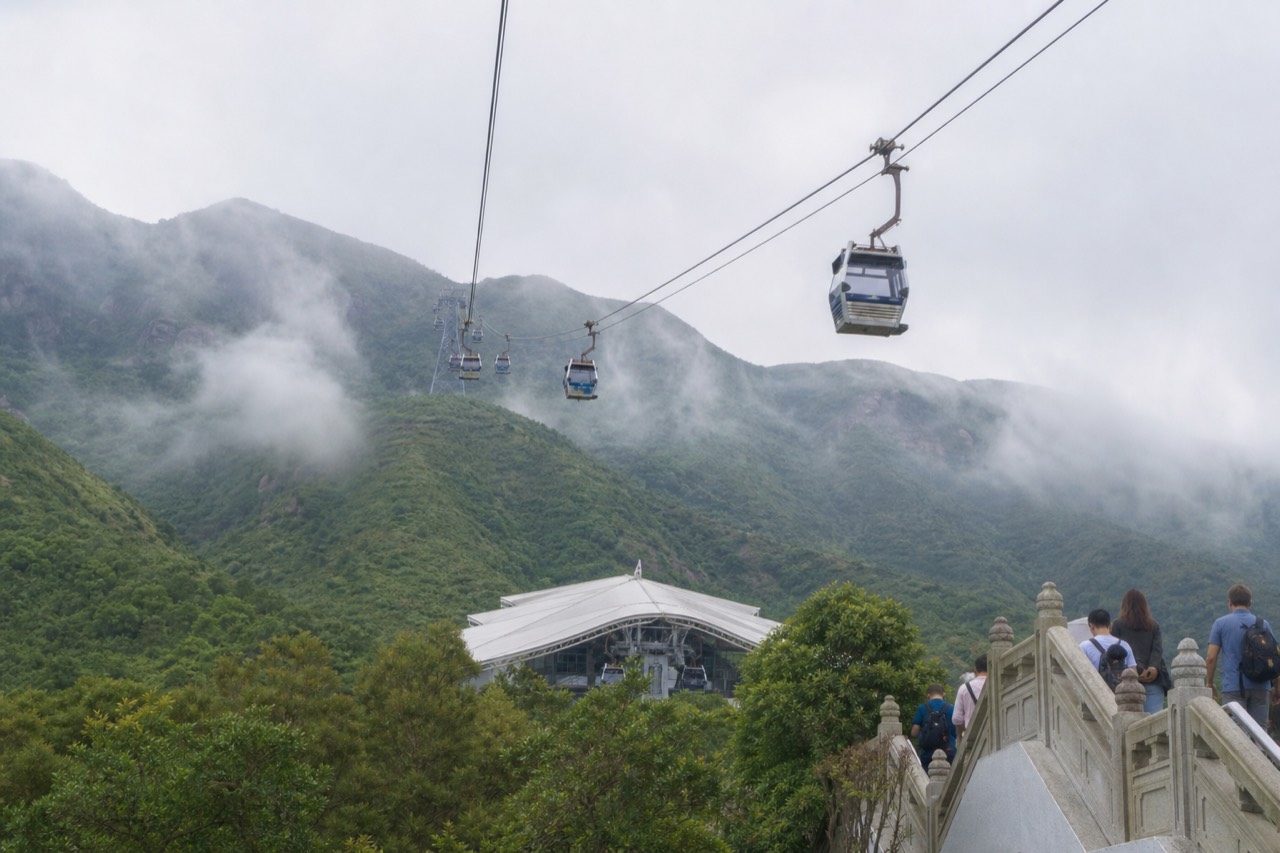
Start with what is fixed. The ropeway is 5.7 km long, the longest bi-cable ropeway in Asia, and the operator quotes approximately 25 minutes one way. Cabins depart continuously from the Tung Chung terminal, so once you are on the boarding platform the wait for a cabin is measured in seconds, not minutes. The ride passes Tung Chung Bay, crosses the airport island, turns a full 60 degrees at the Airport Island Angle Station, and climbs through Lantau North Country Park before the Tian Tan Buddha comes into view near the top (see Why So Popular?). Passengers cannot board or alight at either angle station, so there is no way to shorten the journey.
The practical breakdown looks like this:
| Segment | Time | Notes |
|---|---|---|
| MTR Hong Kong Station to Tung Chung | about 30 minutes | Tung Chung Line, no change of train |
| Walk from Tung Chung Exit B to the terminal | about 5 minutes | roughly 300 m, signposted |
| Ticket purchase or e-ticket scan | minutes with an e-ticket | pre-bought tickets scan at the turnstile |
| Boarding queue, Standard Cabin | highly variable | visitor reports range 1 to 3 hours at peak |
| The ride itself | about 25 minutes each way | 5.7 km, continuous departures |
| Walk from Ngong Ping terminal to the Buddha | about 10 minutes | plus 268 steps to the statue |
The variable line in that table is the boarding queue, and it deserves its own section below. Everything else is predictable to within a few minutes.
If you would rather not manage the queue and the plateau logistics yourself, guided options bundle the cable car with the Buddha and Tai O:
How much total time should you budget for the Big Buddha?
A realistic minimum is five to six hours from Central and back: roughly 30 minutes on the MTR each way, a 25-minute ride each way, and three to four hours on the plateau for the Buddha, the monastery and food, before queueing time is added. The operator itself recommends allowing at least three to four hours just to explore Ngong Ping Village and eat.
Do the arithmetic on a good day. Leave Central at 10:00, reach Tung Chung by about 10:35, walk to the terminal, clear the queue in 30 minutes with a pre-bought e-ticket, and you step off at Ngong Ping around 11:30. The Buddha and the 268 steps take most people 60 to 90 minutes at a relaxed pace with photo stops. Po Lin Monastery opens at 09:00 and closes at 18:00, and its vegetarian kitchen serves from 11:30 to 16:30 daily, so lunch fits naturally into the middle of the visit. Add the return queue and the return ride, and you are back at Tung Chung by 15:30 or 16:00. That is the optimistic version, with no Tai O, no village attractions and a short queue.
A bad day changes the maths sharply. Visitors posting reviews in late 2025 and early 2026 described Standard Cabin waits of one to three hours, including on ordinary weekdays, with one report of 2.5 hours on a November Monday and another of 90 minutes for tickets alone on a January weekday. On a day like that, the queue is the single biggest time cost of the trip, larger than the ride, the steps and the MTR combined. Budget eight hours for the whole outing if you are travelling on a weekend, a public holiday or a mainland holiday week, and treat anything faster as a bonus.
Here is the honest time budget at both ends of the range:
| Scenario | Queue assumption | Total from Central | Back at Central by |
|---|---|---|---|
| Quiet weekday, e-ticket | 15-30 minutes | about 5 hours | mid-afternoon |
| Typical weekend | 45-90 minutes | 6-7 hours | late afternoon |
| Peak holiday, no e-ticket | 2-3 hours | 8 hours or more | evening |
One warning that matters more than any queue: the cable car closes for scheduled maintenance several times a year, not just once, including one long annual overhaul. Ngong Ping Village stays open during closures, but if the ride is the point of your trip, check the operator's announcements before you commit a day.
Wondering whether the whole outing justifies that time? The ticket itself is the cheapest piece of the day.
Does the cabin type change the journey time?
No: Standard, Crystal and Crystal+ cabins all travel the same 5.7 km rope at the same speed, so the ride is about 25 minutes regardless of what you pay. What the cabin type changes is the queue, because Crystal and Crystal+ board through their own shorter line, and visitors consistently report roughly 10 minutes against an hour or more for Standard.
This is the strongest honest framing for the upgrade question: the Crystal Cabin is as much a queue product as a view product. The glass floor, three layers of tempered glass about 4.84 cm thick, gives you the airport and the terrain below your feet, and reviewers repeatedly call the views spectacular on a clear day. But the time saving is what many of them actually praise, because the separate boarding line converts a three-hour day into a two-hour day. The operator's own FAQ calls the Crystal Cabin's popularity "extraordinary" and refuses on-the-day upgrades because of it, which tells you the short line is not a secret.
The premium is real but bounded. An adult round trip costs HK$295 in a Standard Cabin and HK$365 in a Crystal Cabin, about $38 versus about $47 at 7.8403 HKD to the dollar (checked September 2026). Crystal+ , with glass side walls as well as the glass floor, is HK$545 round trip (checked September 2026). A mixed combo, Crystal one way and Standard the other, is HK$330 (checked September 2026), which buys you the glass floor on the quieter leg if you would rather save the difference.
The plain ticket, though, is the product most visitors need, and it is the one this site recommends by default:
The standard ticket listing carries a 4.7 rating from 61,490 reviews (checked September 2026) and starts at $21.15, with free cancellation before redemption on the standard tiers. A pre-bought e-ticket scans at the turnstile with no counter stop, which removes the ticket-purchase queue entirely, though not the boarding line.
How long are the queues, really?
Visitor reports from late 2025 to March 2026 describe Standard Cabin waits of one to three hours, including on non-holiday weekdays, while Crystal and Crystal+ holders report roughly 10 minutes through their own line. A pre-bought e-ticket skips the ticket-purchase queue but does not skip the boarding queue, a distinction reviewers make again and again.
These are reported experiences, not operator statistics, and no published average exists. But the pattern is consistent enough to plan around. The reports include 2.5 hours on a November Monday that was not a holiday, 1 hour 45 minutes in March 2026, and roughly 90 minutes for tickets alone plus more for boarding on a weekday in January 2026. Peak periods are worse: summer, Golden Week and Christmas, when the operator's own figures showed the Crystal+ cabins running above 90% utilisation in 2024.
| Reported wait | Date reported | Cabin | Source type |
|---|---|---|---|
| 2.5 hours | November Monday, not a holiday | Standard | visitor review |
| 1 hour 45 minutes | March 2026 | Standard | visitor review |
| 90 minutes for tickets plus boarding | January 2026 weekday | Standard | visitor review |
| Roughly 10 minutes | multiple 2025-26 reports | Crystal / Crystal+ | visitor reviews |
Two structural facts explain the waits. First, 2024 drew 1.56 million guests, an average of about 4,843 a day, through a boarding system where every Standard passenger re-queues for the return leg too, since you cannot stay in the same cabin. Second, the operator opens earlier on weekends precisely because weekends are busier: hours are 10:00 to 18:00 on weekdays and 09:00 to 18:30 on Saturdays, Sundays and public holidays (checked September 2026).
The timing tactics that follow from the reports are simple. Go on a weekday if you can. Arrive for the first cabin of the day, when the queue is shortest. Buy the e-ticket in advance so a counter is never part of your morning. And if your date is fixed on a holiday weekend and time is tight, treat the Crystal premium as a queue fee rather than a luxury.
What adds time at the top, and what skips it?
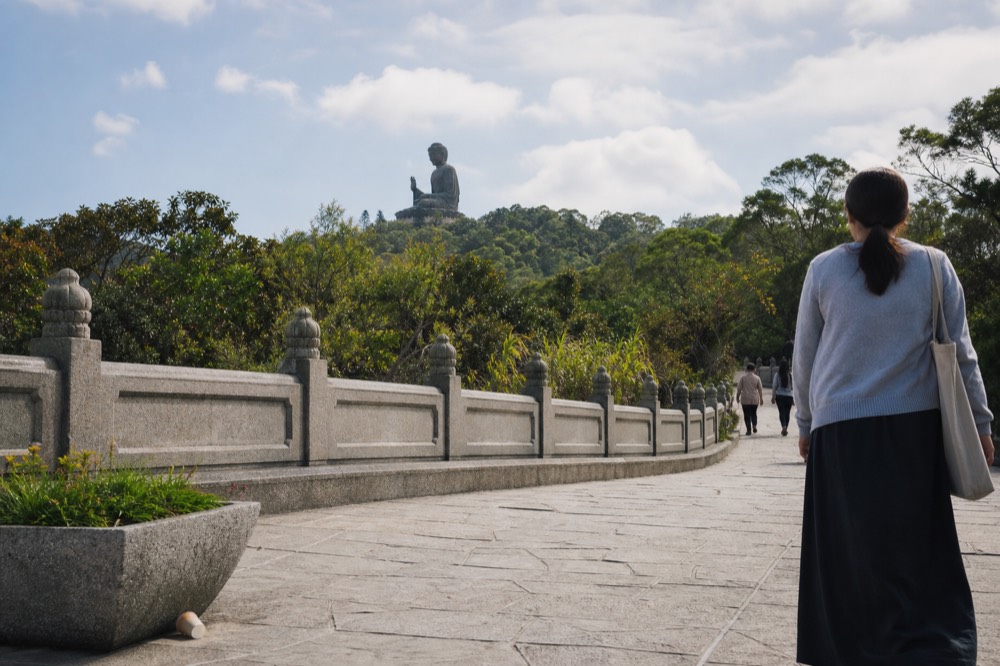
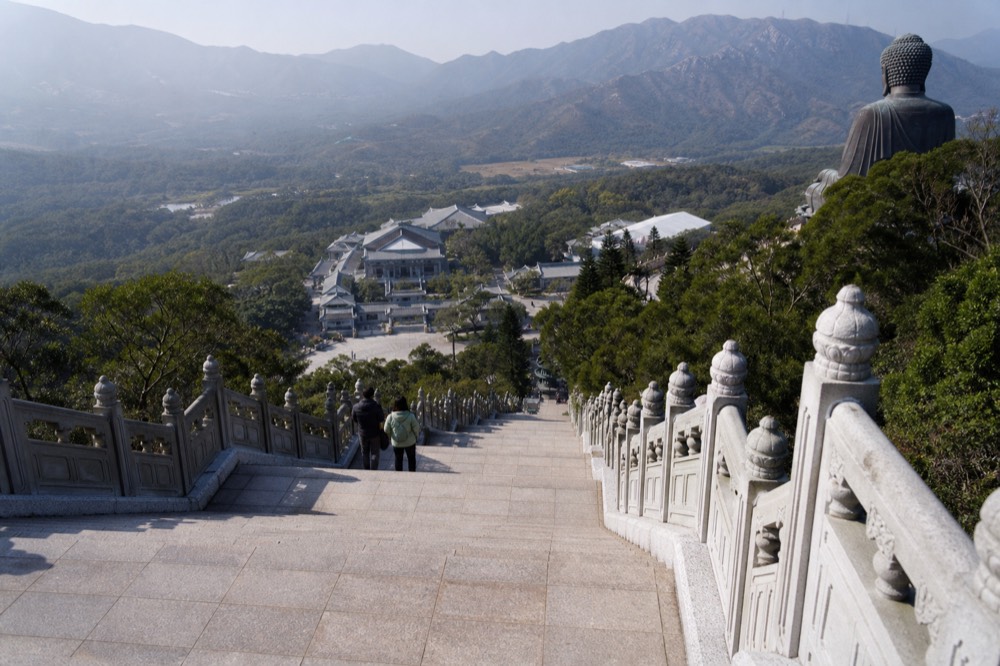
The Big Buddha is 10 minutes on foot from the cable car terminal plus 268 steps to the statue, which most people cover in 60 to 90 minutes with photos; Po Lin Monastery is next to it, and the vegetarian kitchen serves from 11:30 to 16:30, so a sit-down lunch adds 45 minutes to an hour. Tai O fishing village adds a further half day if you include it.
The steps are free to climb and the figure is verified on the Hong Kong Tourism Board's own page: 268 from the plaza to the statue. The statue itself rewards a pause even before you climb. It was built over 12 years from 202 bronze sections, and its face was cast as a single 5-tonne piece, 4.3 m by 5.8 m, which had to be carried up Lantau's narrow roads on a lorry sandwiched between two cranes. The whole statue was wind-tunnel tested in the Beijing facility built for satellites and rockets before assembly was finished in 1989.
One correction that most older guides get wrong: the Wisdom Path, the 38 timber columns carrying the Heart Sutra in a figure-of-eight at the foot of Lantau Peak, has been closed since 5 June 2025 for refurbishment, with completion expected in the last quarter of 2026. Do not build it into your walking time this year. A viewing platform on a nearby Lantau Trail section stays open.
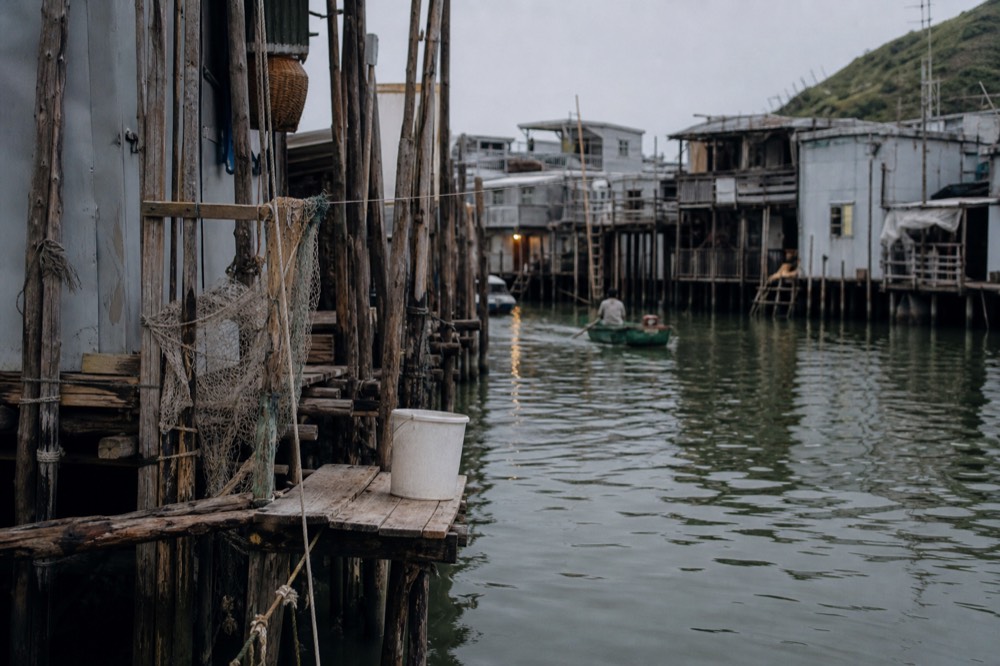
If you want Tai O as well, New Lantao Bus 21 runs from the Ngong Ping bus terminus, about 5 minutes on foot from the village, to Tai O in roughly 20 minutes for HK$7.90 on a normal day, or HK$19.20 on a Sunday or public holiday (checked September 2026). The stilt-house boat excursion is a 20-minute ride from the main street. Realistically the Buddha plus Tai O is a full day, which is exactly why guided tours exist: a five-hour option bundles the cable car, the Buddha and a Tai O boat ride, while a VIP version adds priority boarding to strip the queue out of the equation.
The guided alternative suits visitors who would rather not calculate any of this. A 5-hour tour covering the cable car, the Big Buddha and Tai O is rated 4.7 from 652 reviews and starts at $67.6 (checked September 2026), against $70.15 for a 6-hour version rated 4.8 from 490 reviews (checked September 2026). Both cost more than a bare ticket, but they convert the plateau's loose variables, the queue, the bus, the boat, into a fixed schedule.
| At the top | Typical time | Notes |
|---|---|---|
| Walk to the Buddha and climb 268 steps | 60-90 minutes | free to climb |
| Po Lin Monastery and vegetarian lunch | 45-60 minutes | kitchen 11:30-16:30 daily |
| Ngong Ping Village and attractions | 1-2 hours | operator suggests 3-4 hours including food |
| Bus 21 to Tai O and back plus village | 2-3 hours | about 20 minutes each way by bus |
For more on the monastery itself, see the Po Lin Monastery guide, and the full Lantau day trip itinerary lays out the same plateau in a full-day order.
When should you ride to keep the day short?
October and November are the statistical sweet spot: the lowest humidity of the year, 197.8 and 172.3 sunshine hours respectively, minimal rain, no recorded fog days and fading typhoon risk, while February to April concentrates nearly all of Hong Kong's 3.7 annual fog days and August averages the most tropical cyclone signal days at 4.17.
Fog is the hidden time cost nobody prices in. Hong Kong averages only 3.70 fog days a year, but 3.40 of them fall in February, March and April, exactly the months that also post the year's lowest sunshine. A ride through low cloud on the Ngong Ping plateau is still 25 minutes, but it is 25 minutes of white, and there is no refund policy published for fog alone. The operator's stated exchange and refund terms cover weather and service suspensions generally, handled at either terminal or by email.
Typhoons are the summer risk. The 2006 design specification, from a Hong Kong Legislative Council reply and not from any current operator policy, set suspension at sustained winds of 90 km/h or gusts reaching 135 km/h. Observatory data collected at Ngong Ping found those conditions existed on an average of 7 days a year inside operating hours. The operator publishes no current numeric threshold, so treat those figures as design history, not live policy, and check the hotline or the operator's site on the day.
Timing within the day matters as much as timing within the year. The first departures at 10:00 on weekdays and 09:00 on weekends face the shortest queues, and the last boarding time on normal days is not published anywhere by the operator, so do not plan a late-afternoon ride against an assumed cutoff. If your schedule is tight, morning is the only safe shape for the day.
The short version
The flight itself is fixed: about 25 minutes each way across 5.7 km. The full experience is not, running five to eight hours depending on the Standard Cabin queue and whether Tai O joins the itinerary. An e-ticket skips the counter, a Crystal or Crystal+ ticket skips most of the boarding line, and a guided tour skips the planning. Check the maintenance calendar first, and pick October if you can.
This site, Hong Kong Ngong Ping Cable Car, exists to keep exactly those numbers straight, because the difference between a 25-minute ride and an eight-hour day is the difference between a good plan and a missed dinner. The ride never changes. The queue, the season and the closure calendar are what you can actually control, and each of them has its own section above.
These are the questions visitors ask most about the timing of the Ngong Ping cable car trip to the Big Buddha: the length of the ride itself, the double queue on a round trip, what a pre-bought ticket actually skips, and how the closure calendar can change the plan.
Common questions about the cable car ride to the Big Buddha
How Long Is the Cable Car Ride to the Big Buddha?
About 25 minutes each way, covering 5.7 km from Tung Chung to the Ngong Ping plateau. Cabins depart continuously, so there is no timetable to catch. Budget five to six hours for the full outing from Central, more on a busy weekend.
Do you have to queue twice if you ride both ways?
Yes. You cannot stay in the same cabin for the return leg; you alight at Ngong Ping and rejoin the boarding queue for the ride back. This is why the queue can cost more time than the ride itself.
Does a pre-bought ticket skip the queue?
It skips the ticket-purchase queue, because plain cable car e-tickets scan at the turnstile with no counter stop. It does not skip the boarding queue. Reviewers consistently report that distinction.
Is the Crystal Cabin faster?
The ride takes the same 25 minutes. But Crystal and Crystal+ cabins board through their own much shorter line, with visitors reporting roughly 10 minutes against an hour or more for Standard, so the upgrade saves queue time rather than travel time.
How long do I need at the Big Buddha itself?
About 60 to 90 minutes for the 10-minute walk and the 268 steps, longer if you add Po Lin Monastery and its vegetarian kitchen, which serves from 11:30 to 16:30 daily. The operator suggests three to four hours for the village and food combined.
Can the cable car be closed when I arrive?
Yes. It closes for scheduled maintenance several times a year, including a long annual overhaul, and suspends in severe weather. Ngong Ping Village stays open during maintenance closures, and New Lantao Bus 23 is the road alternative from Tung Chung.