How Many Steps to Reach Tian Tan Buddha?
There are 268 steps to the Tian Tan Buddha at Ngong Ping, free to climb. What the stairway is like in Hong Kong heat and humidity, and the no-steps alternatives.
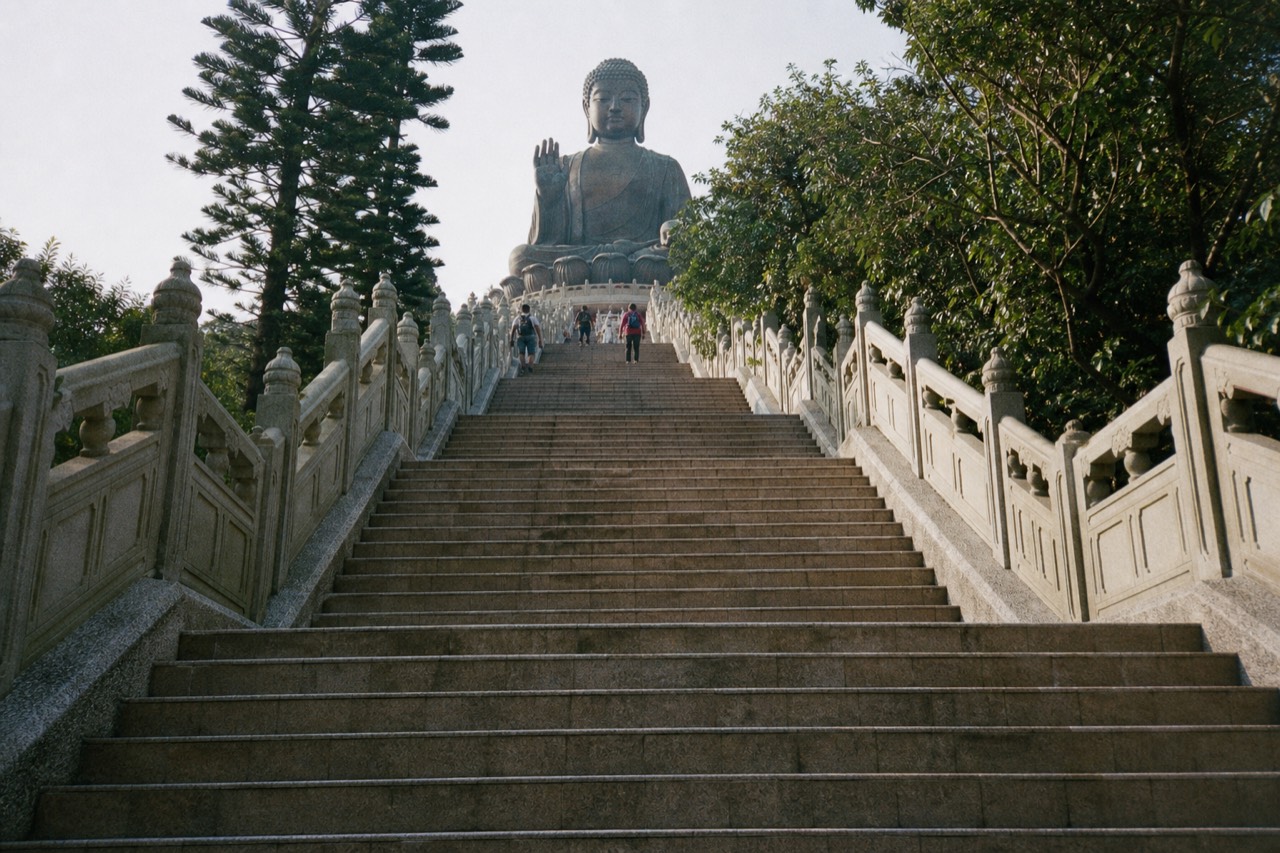
Every guide to Lantau repeats a number: 268. It is the count of stone steps between the plaza at Ngong Ping and the base of the Tian Tan Buddha, the bronze statue that has watched over the island since 1993. The number is correct, and the Hong Kong Tourism Board has confirmed it on its own page for the statue.
What most guides skip is the part that actually decides your day. Those steps are fully exposed to the sun, and Hong Kong summers run hot, wet and airless. The climb is free, untimed and genuinely worth doing, but it deserves honest preparation rather than a throwaway line. And if your knees, your schedule or the weather rule it out, the plaza below offers more than most visitors expect.
How Many Steps to Reach Tian Tan Buddha?
There are exactly 268 steps from the plaza at Ngong Ping up to the Tian Tan Buddha, and the climb is free, with no ticket, turnstile or timed entry at any point. The figure comes straight from the Hong Kong Tourism Board, and it is the same count whether you arrive by cable car, bus or on foot.
The stairway is wide, built of dressed stone, and broken by landings every dozen or so steps, so it never feels like a ladder. It rises in a straight line up the slope of Mount Muk Yue, with the statue growing above you as you go. You can stop at any landing without blocking the flow, and in practice most people do, because the humidity decides the pace more than the gradient does. One curiosity in the official record: a separate Hong Kong Tourism Board page counts 256 steps to the hall inside the statue's base, a slightly different measurement to a slightly different door. The number that matters for planning is 268.
The bottom of the stairway sits about ten minutes on foot from Ngong Ping Village, immediately beside Po Lin Monastery, so the walk from the cable car terminal is flat before the climbing starts. The monastery keeps its own hours, 09:00 to 18:00 (checked September 2026), which means it opens before the cable car does on a weekday. Climbing the exterior steps costs nothing at any hour the site is open, and there is no separate queue for the stairs, only for the cable car that gets you there.
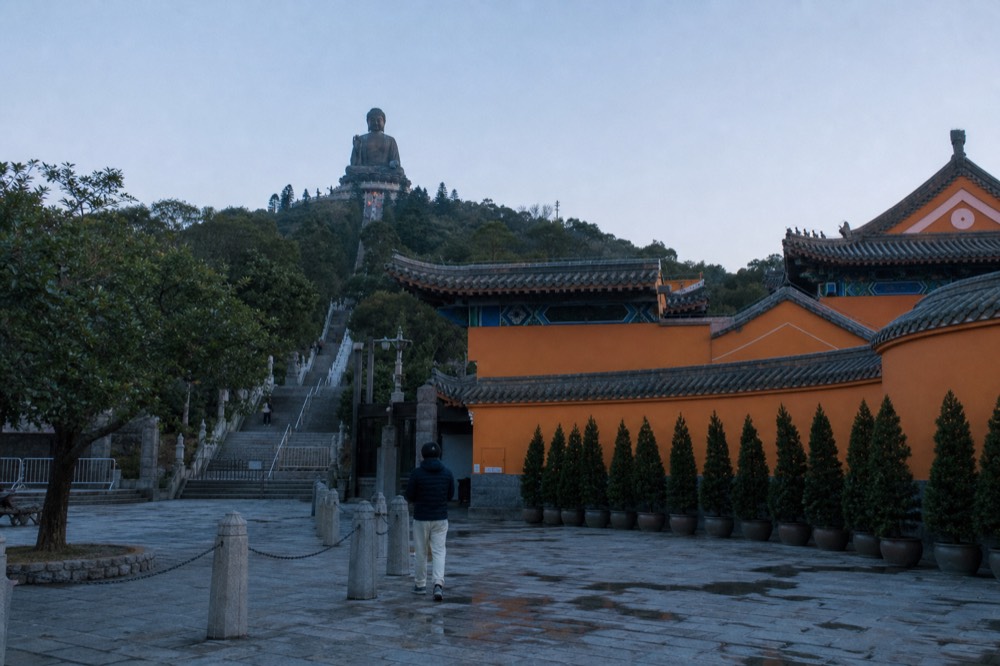
The count is verified, but the surroundings have changed recently, and several current facts are worth knowing before you plan the day:
For the full background on the statue itself, see our complete guide to the Big Buddha.
What Is the Climb Like in Hong Kong Heat and Humidity?
The steps are exposed stone with almost no shade, so Hong Kong's heat and humidity are the real challenge rather than the count. Summer highs average above 30 degrees Celsius, and the climb is genuinely hard work from June to September, while late October into December brings cooler, drier, clearer conditions.
The Hong Kong Observatory's 1991 to 2020 normals, recorded at its headquarters near sea level, tell the story in numbers. August averages a daily maximum of 31.3 degrees with 81 percent relative humidity, and June is the wettest month of all at 491.5 mm of rain. Ngong Ping sits high on the plateau and runs cooler, wetter and cloudier than those urban figures, so treat them as a floor rather than a forecast. What they establish clearly is the shape of the year: a long, oppressive summer and a short, excellent autumn.
| Month | Mean daily max | Relative humidity | Rainfall | Fog days |
|---|---|---|---|---|
| February | 19.4 °C | 79% | 38.9 mm | 1.10 |
| March | 21.9 °C | 82% | 75.3 mm | 1.47 |
| April | 25.6 °C | 83% | 153.0 mm | 0.83 |
| June | 30.7 °C | 82% | 491.5 mm | 0.00 |
| August | 31.3 °C | 81% | 453.2 mm | 0.00 |
| October | 28.1 °C | 73% | 120.3 mm | 0.00 |
| November | 24.5 °C | 72% | 39.3 mm | 0.00 |
| December | 20.4 °C | 70% | 28.8 mm | 0.03 |
Two seasonal risks sit inside that table. Visibility is a late-winter and spring problem: Hong Kong averages only 3.70 fog days a year, and 3.40 of them fall in February, March and April, exactly the months with the year's lowest sunshine. A February climb can put you inside cloud, with the statue appearing only in the last few steps. Typhoon signals are the summer problem, peaking in August at an average of 4.17 signal days, and the ride up suspends in severe weather even when the steps themselves remain walkable.
October and November are the statistical sweet spot: the year's lowest humidity, high sunshine, almost no fog, and cyclone risk falling away. If your dates are fixed in summer, go early. The cable car starts at 10:00 on weekdays and 09:00 on weekends and public holidays (checked September 2026), and the monastery opens at 09:00, so a first-cabin arrival puts you at the bottom of the steps before the worst of the midday heat. Carry water, use the landings, and treat the climb as a slow 15 minutes rather than a sprint. For the longer walking routes in the hills around the statue, our guide to hiking to the Big Buddha covers them in detail.
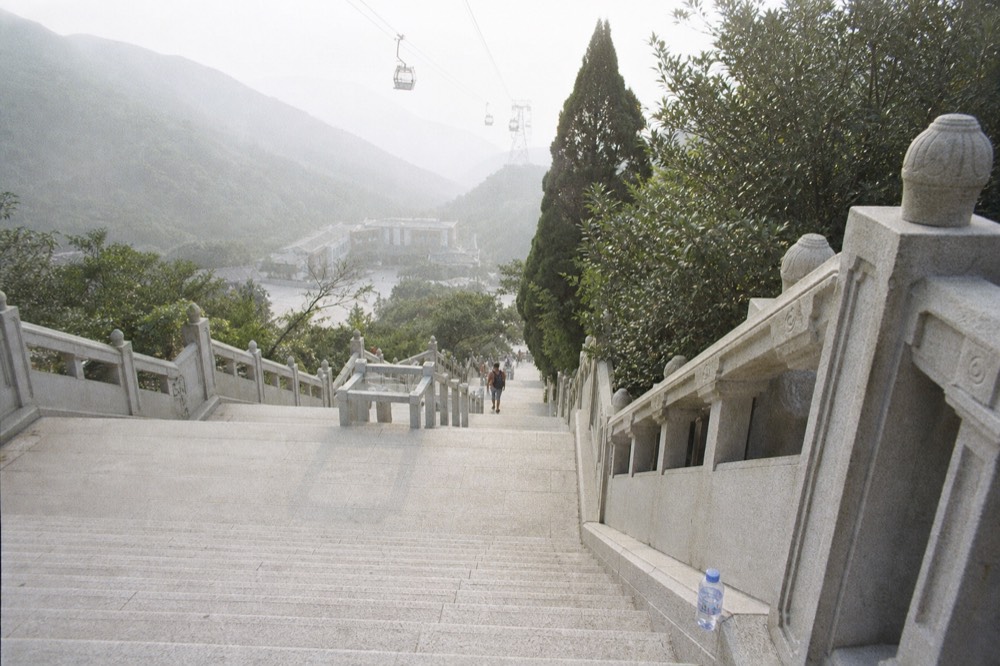
However you decide to reach the plateau, the three options below cover the realistic ways to build the day around the climb:
What If You Cannot Manage the Steps?
Yes, you can skip the steps entirely and still see plenty, because the Buddha is visible in full from the plaza below and everything around it stays free to wander. Po Lin Monastery, the Ngong Ping Village boardwalk and the viewing platform all sit at plaza level, no stairs required.
The plaza view is not a consolation prize. The statue stands 34 metres in total from lotus throne to crown, and from the flat ground beside the monastery you see the whole figure, the mountain behind it and the sea beyond. Photographers often prefer the plaza precisely because the statue needs distance to fit in frame. The climb rewards you with proximity, the view down over the plateau and the detail of the bronze, but nobody who stays below leaves without having seen the Buddha.
The monastery itself is the strongest no-steps option. Its halls, courtyards and incense terraces are all at plaza level, and the vegetarian kitchen serves a fixed communal set meal from 11:30 to 16:30 daily (checked September 2026). The monastery publishes no price for that meal, so expect to pay at the door and check on the day. Our guide to Po Lin Monastery covers the layout, the kitchen and the snack shop.
| Option | What you get | Cost |
|---|---|---|
| The plaza view | The full 34 m statue, mountain backdrop, photography | Free |
| Po Lin Monastery | Halls, courtyards, vegetarian kitchen 11:30 to 16:30 | Grounds free, meal price not published |
| Ngong Ping Village | 1.5-hectare boardwalk, cafes, attractions | Free to walk, HK$20 per attraction upgrade (checked September 2026) |
| Ngong Ping Viewing Platform | Raised panorama over the plateau | Free |
Ngong Ping Village deserves more credit than it gets as a fallback. It is a 1.5-hectare boardwalk of shops, cafes and small attractions next to the cable car terminal, and the operator recommends allowing three to four hours to explore it and eat. Two of its indoor attractions, the Cable Car Discovery Centre and Motion 360, can be added for HK$20 each on top of any cable car ticket (checked September 2026). Between the plaza, the monastery and the village, a visitor who never touches a step can fill half a day.
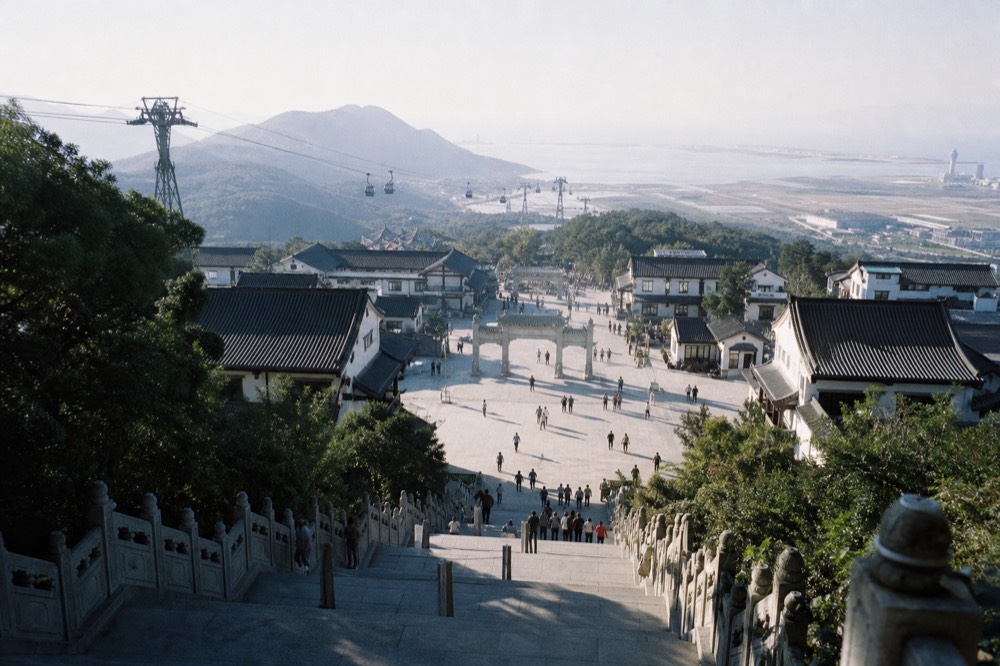
How Was the Tian Tan Buddha Built?
The statue took twelve years to build and was assembled from 202 separate bronze pieces totalling about 250 tonnes, with the face cast as a single five-tonne slab. It was wind-tunnel tested in Beijing, in the facility built for satellites and rockets, before the final piece went up in October 1989.
The story, told in detail by Po Lin Monastery on its own site, starts with a government land grant in 1974: 6,567 square metres on Mount Muk Yue at a nominal premium. A construction committee formed in December 1981, and a sculptor at the Guangzhou Institute of Fine Arts spent two years on a 1:5 plaster model, revising it eight times before it was approved. The bronze was then cast at a machinery plant in Nanjing, in 202 separate pieces each 10 to 13 mm thick, held to a tolerance of under 3 mm.
The face was the monster piece. Cast as a single slab 4.3 by 5.8 metres and five tonnes in weight, it had to be carried up Lantau's narrow winding roads on a lorry sandwiched between two cranes. Before anything was shipped, the whole statue was wind-tunnel tested by the Beijing Institute of Aerodynamics, using the wind tunnel built for satellites and rockets, in both whole and sectional form. The last bronze piece was placed on 13 October 1989, and the inaugural ceremony followed on 29 December 1993. The statue faces north, towards Beijing, with the right hand raised in the fearlessness gesture and the left resting on the lap.
| Fact | Figure |
|---|---|
| Body height | 26.4 m |
| Total height with throne and base | 34 m |
| Bronze | About 250 tonnes in 202 pieces |
| The face | One casting, 4.3 x 5.8 m, 5 tonnes |
| Build time | 12 years |
| Final piece placed | 13 October 1989 |
| Inauguration | 29 December 1993 |
Knowing the engineering changes how the climb feels. Those 268 steps end at a structure that was modelled on the Altar of Heaven in Beijing, cast to rocket-programme tolerances and tested in a satellite wind tunnel. Few stairways in the world finish anywhere near it.
How Do You Get to the Bottom of the Steps?
Most visitors take the MTR to Tung Chung, walk about five minutes from Exit B to the cable car terminal, then ride the 5.7 km ropeway up to Ngong Ping, which lands you a ten-minute stroll from the steps. The whole journey from Central takes roughly 70 minutes door to platform.
The rail leg is simple. The Tung Chung Line runs direct from Hong Kong Station to Tung Chung in about 30 minutes, costing HK$24.30 with an Octopus card or HK$28.00 for a single-journey ticket (checked September 2026). From Kowloon or Tsim Sha Tsui the Octopus fare is HK$18.70. The cable car terminal sits beside the station, about 300 metres and five minutes from Exit B, much of it under cover.
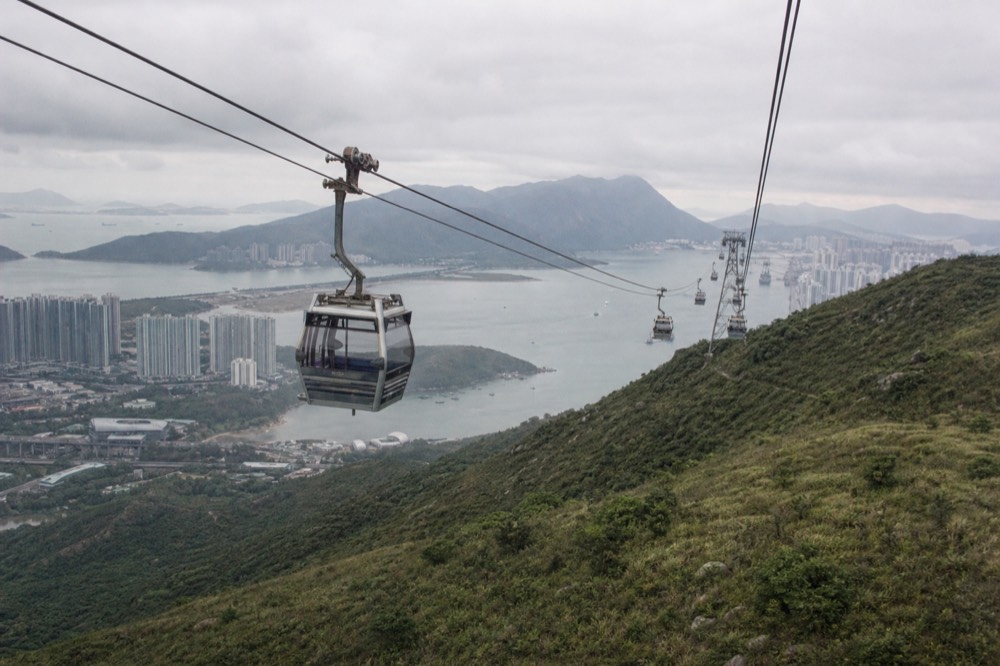
The ropeway is the main event of the approach. It is the longest bi-cable ropeway in Asia at 5.7 km, carries 108 cabins, and takes about 25 minutes each way, turning a full 60 degrees at the Airport Island Angle Station. An adult round trip in a Standard Cabin costs HK$295 at the gate, about $38, with the glass-floor Crystal Cabin at HK$365 (checked September 2026). The live listing for the ticket product sells from $21.15 one way and $29.39 round trip, rated 4.7 across 61,490 reviews (checked September 2026), with free cancellation before redemption on the standard tiers. A pre-bought e-ticket scans straight through at the turnstile, which skips the ticket-purchase queue but not the boarding line, a distinction recent visitor reports make repeatedly.
Ngong Ping 360, the operator, is a subsidiary of the MTR Corporation, so the same company runs the train that brings you and the cable car that lifts you. For the full fare ladder, cabin comparison and closure calendar, see the coverage at Hong Kong Ngong Ping Cable Car.
Fares and hours below are the published figures (checked September 2026).
| Leg | Option | Cost | Time |
|---|---|---|---|
| Central to Tung Chung | MTR Tung Chung Line | HK$24.30 Octopus / HK$28.00 single | About 30 min |
| Kowloon or TST to Tung Chung | MTR Tung Chung Line | HK$18.70 (checked September 2026) Octopus | About 30 min |
| Tung Chung Station to terminal | Walk from Exit B | Free | About 5 min |
| Tung Chung to Ngong Ping | Cable car | HK$295 (checked September 2026) adult round trip Standard | About 25 min each way |
| Tung Chung to Ngong Ping | NLB bus 23 | HK$20.40 weekday / HK$37.00 Sunday and holiday | Not published |
Two planning notes sit inside that table. The bus fare nearly doubles on Sundays and public holidays, exactly the days people need the fallback, and the operator publishes no journey time for it. More important: the cable car closes repeatedly through the year for maintenance, including 8 to 18 September 2026 (checked September 2026), and it closed for shorter periods in January, March, May and June 2026 as well. Ngong Ping Village stays open during these closures, and bus 23 is the standing alternative, climbing the winding Tung Chung Road over the mountain.
What Else Is Around the Buddha Once You Have Climbed?
Once your legs recover, the plateau around the statue holds a monastery, a village boardwalk and trailheads for one of Hong Kong's toughest sunrise hikes, though the famous Wisdom Path is currently shut. The Buddha's own plaza also looks out over the Lantau hills and the sea beyond.
The Wisdom Path is the fact most guides get wrong. It has been closed since 5 June 2025 for refurbishment, with the Tourism Commission expecting works to finish in the last quarter of 2026 and reopening to happen gradually, in stages. The path itself is a figure-of-eight arrangement of 38 timber columns carved with the Heart Sutra, the highest column left deliberately blank to express emptiness. Until it reopens, a viewing platform on a nearby section of the Lantau Trail stays open, with QR codes linking to the site's history. Do not plan a visit around it yet.
Above the plateau, Lantau Peak rises 934 metres, Hong Kong's second-highest summit, and the sunrise hike from the Ngong Ping side is a local rite of passage. Reported ascent times run 1.5 to 2.5 hours depending on route and fitness, though these are third-party estimates rather than published figures, and the stone steps make it as demanding as anything at that height in Hong Kong. It is a serious walk, not an extension of the Buddha visit.
The gentler onward option is Tai O, Hong Kong's oldest fishing village, reached by New Lantao Bus 21 from the Ngong Ping bus terminus in about 20 minutes for HK$7.90 on a normal day, or HK$19.20 on a Sunday or public holiday (checked September 2026). The village is known for its stilt houses, and the 20-minute boat excursion from the footbridge passes them along with the former police station, now a heritage hotel. If stitching the cable car, the Buddha and Tai O into one day without any of the planning appeals, a five-hour guided tour covering all three is rated 4.7 from 652 reviews (checked September 2026), with the price on the live listing.
Onward costs below are the published fares (checked September 2026).
| From Ngong Ping | Option | Cost |
|---|---|---|
| Tai O | NLB bus 21, about 20 min | HK$7.90 normal day / HK$19.20 Sunday and holiday |
| Lantau Peak summit | Hike via Lantau Trail | Free |
| Village attractions | HK$20 (checked September 2026) upgrade per attraction with any cable car ticket | HK$20 each |
Put together, a realistic day looks like this: first cable car up, the steps before the heat builds, an hour for the statue and monastery, lunch at the vegetarian kitchen or in the village, then either the bus to Tai O or a slow afternoon on the boardwalk. Budget five to six hours if Tai O is on the list, and check the maintenance calendar before you lock a date, because the one thing that stops this plan dead is a ropeway that is not running.
The Tian Tan Buddha stands 268 steps above the Ngong Ping plaza, a free climb confirmed by the Hong Kong Tourism Board that takes most visitors about 15 minutes in summer heat. The questions below cover the cost, the difficulty, the wheelchair and weather limits, and the best hour to start, with current figures throughout.
Common questions about the steps to Tian Tan Buddha
How Many Steps to Reach Tian Tan Buddha?
There are 268 steps from the plaza at Ngong Ping to the base of the statue, a count confirmed by the Hong Kong Tourism Board. The climb is free, with no ticket or timed entry, and takes most visitors a slow 15 minutes in summer heat.
Is it free to climb the steps to the Tian Tan Buddha?
Yes. Climbing the exterior steps costs nothing, at any hour the site is open. There is no entrance fee for the plaza, the steps or the view from the top, and no ticket is checked anywhere on the stairway.
How hard are the 268 steps, really?
The gradient is gentle and the stairway is wide with regular landings, but the exposure is the problem. In summer the climb is hard work in 30-degree heat and 80 percent humidity, so go early, carry water and use the landings. From October to December the same climb is comfortable for most reasonably fit visitors.
Can wheelchair users reach the Tian Tan Buddha?
The statue itself sits atop 268 steps and cannot be reached by wheelchair. The plaza, Po Lin Monastery grounds and Ngong Ping Village are all at plaza level and walkable without stairs, and the cable car accepts wheelchair users travelling with an able-bodied companion, with a boarding platform level with the cabin floor.
Is the Wisdom Path near the Buddha open?
No. The Wisdom Path has been closed since 5 June 2025 for refurbishment, with completion expected in the last quarter of 2026 and a staged reopening after that. A viewing platform on a nearby section of the Lantau Trail remains open in the meantime.
What is the best time of day to climb?
Early morning, before the midday heat builds. The cable car starts at 10:00 on weekdays and 09:00 on weekends and public holidays (checked September 2026), and the monastery opens at 09:00, so a first-cabin arrival puts you at the steps at the coolest workable hour. October and November offer the most reliable clear skies of the year.