Hong Kong Airport to Big Buddha: The Layover Guide
Hong Kong International Airport and the Big Buddha share one island, and the operator puts the cable car terminal about 20 minutes from the terminal building. Whether a layover visit actually works comes down to luggage, queues and the closure calendar.
Short answer
Yes, on a layover of six hours or more. The Tung Chung cable car terminal sits about 20 minutes from Hong Kong International Airport, the ride takes 25 minutes each way, and an adult round trip costs HK$295. Cabin luggage is capped at 48 x 34 x 23 cm and 4 kg, with left luggage at HK$100 a piece.
Hong Kong International Airport stands on reclaimed land off the north coast of Lantau, and the Tian Tan Buddha stands on the same island's western plateau, roughly 25 minutes of travel apart once you count the road hop and the gondola. Very few major airports sit this close to a 34-metre bronze statue reached by a 5.7 km ropeway. That geography is why the route from Hong Kong airport to the Big Buddha has become a genuine layover plan rather than a fantasy, and also why it fails for people who arrive unprepared: the cable car closes for maintenance several times a year, the boarding queue can eat half a day, and anything bigger than a small daypack is barred from the cabins by bylaw.
This guide walks the whole decision: the transfer from the airport to Tung Chung, the luggage rules that decide whether your suitcase can come, the fare ladder, the time budget on the plateau, and the fallback bus when the ropeway is shut.
How far is Hong Kong airport from the Big Buddha?
The Big Buddha sits on Lantau's Mount Muk Yue, roughly 25 minutes by road and cable car from Hong Kong International Airport, which itself occupies the northern edge of the same island. The operator describes the Tung Chung cable car terminal as about 20 minutes from the airport, and that terminal sits directly beside the MTR station at Tung Chung.
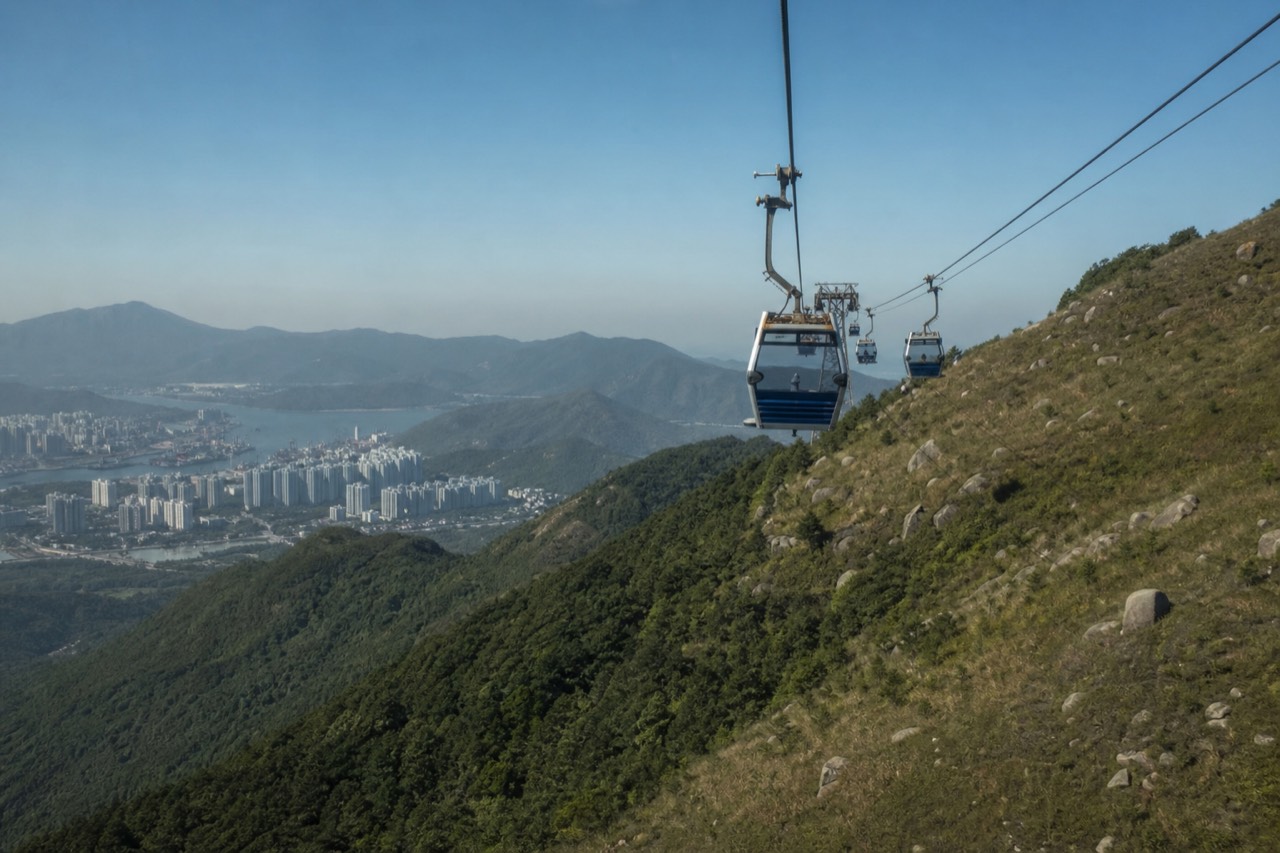
Straight-line distance flatters the trip less than you would hope. The airport and Tung Chung face each other across a short stretch of coast, but the Buddha stands high on the Ngong Ping plateau, and there are only two ways up: the cable car or the winding Tung Chung Road by bus. The ropeway is the reason the trip works at all, because it turns a nauseating mountain drive into a 25-minute glide with the airport, the South China Sea and the Hong Kong–Zhuhai–Macau Bridge below.
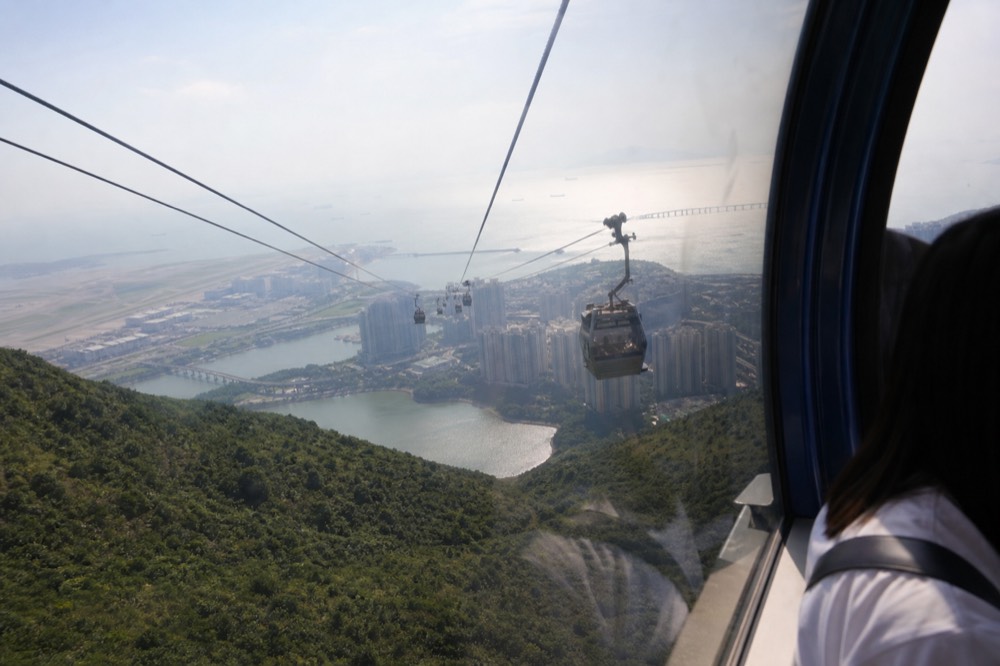
The airport's position on Lantau is the quiet fact underneath every version of this plan. Most visitors reach the Buddha from Kowloon or Hong Kong Island and spend 30 minutes on the Tung Chung Line before they even see the terminal; you start from the near side. A traveller landing at 09:00 can realistically be on the plateau before noon, which is not true of almost any other major-city layover attraction of this scale.
What the short distance does not buy you is slack. The queue, not the distance, is the variable that breaks tight schedules, and the sections below treat it accordingly.
Can you visit the Big Buddha during a Hong Kong layover?
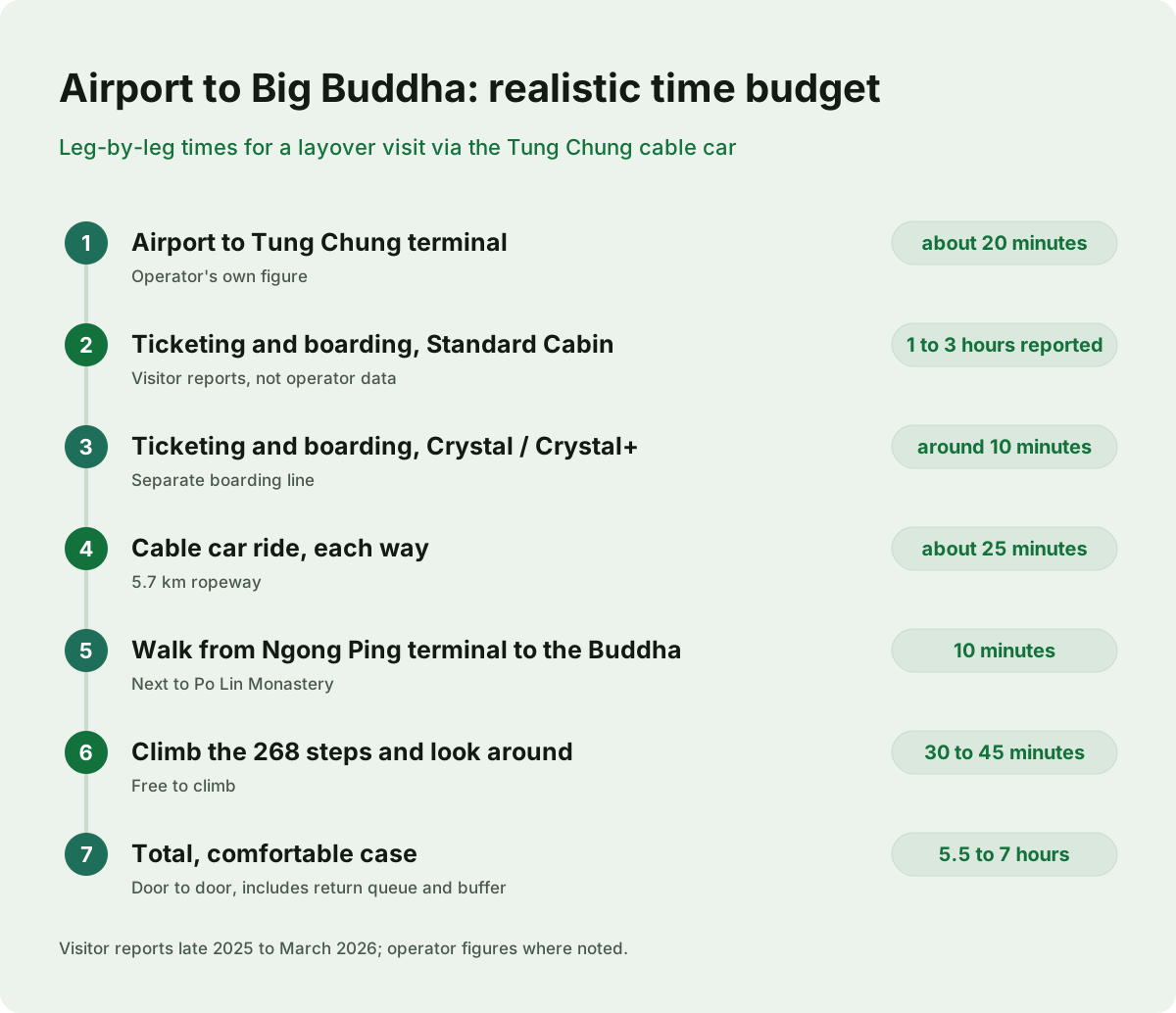
Yes, if the layover runs six hours and the cable car is running. The realistic budget is about 20 minutes from the airport to Tung Chung, a boarding queue visitors report at one to three hours for Standard cabins, a 25-minute ride each way, and two to three hours on the plateau. Under five hours the maths stops working.
The honest arithmetic matters more here than enthusiasm. Recent visitor reports, dated from late 2025 through March 2026, describe Standard Cabin waits of one to three hours, including on ordinary weekdays: two and a half hours on a November Monday, an hour and three quarters in March 2026, and roughly 90 minutes just for tickets plus more for boarding on a January weekday. These are individual reports rather than operator statistics, so treat them as a warning range, not a promise. Crystal and Crystal+ cabins board through a separate, much shorter line, which reviewers put at around ten minutes, and that difference is often what makes a mid-length layover viable.
A pre-bought e-ticket helps, but only halfway. Plain cable car tickets bought online are scanned at the turnstile with no counter step, so you skip the ticket-purchase queue, yet you still join the boarding queue like everyone else. Reviewers make exactly this distinction repeatedly, and it matches the operator's own ticket terms. The practical reading: buy ahead to remove one queue, and pick your cabin tier with the other queue in mind.
| Leg | Realistic time | Notes |
|---|---|---|
| Airport to Tung Chung terminal | about 20 minutes | Operator's own figure for the terminal transfer |
| Ticketing and boarding, Standard Cabin | 1 to 3 hours reported | Visitor reports late 2025 to March 2026, not operator data |
| Ticketing and boarding, Crystal / Crystal+ | around 10 minutes reported | Separate boarding line |
| Cable car ride, each way | about 25 minutes | 5.7 km, continuously moving cabins |
| Walk from Ngong Ping terminal to the Buddha | 10 minutes | Next to Po Lin Monastery |
| Climb the 268 steps and look around | 30 to 45 minutes | Free to climb |
| Total, comfortable case | 5.5 to 7 hours door to door | Includes return queue and buffer |
Two caveats keep this honest. First, a round trip's two legs are valid on the same day only, and you cannot stay in your cabin at the top; you alight and rejoin the boarding queue for the return. Second, the operator recommends allowing three to four hours just to explore Ngong Ping Village and eat, so a serious visit wants more layover than a rushed one. Our Hong Kong Ngong Ping Cable Car coverage keeps the closure calendar and fare table current so you can check both before committing.
If you would rather not run this arithmetic yourself, or your layover sits in the awkward five-to-six-hour band, a guided product moves the queue and the clock to someone else. These are the three options that fit the airport-to-Buddha plan best:
What luggage can you take on the cable car?
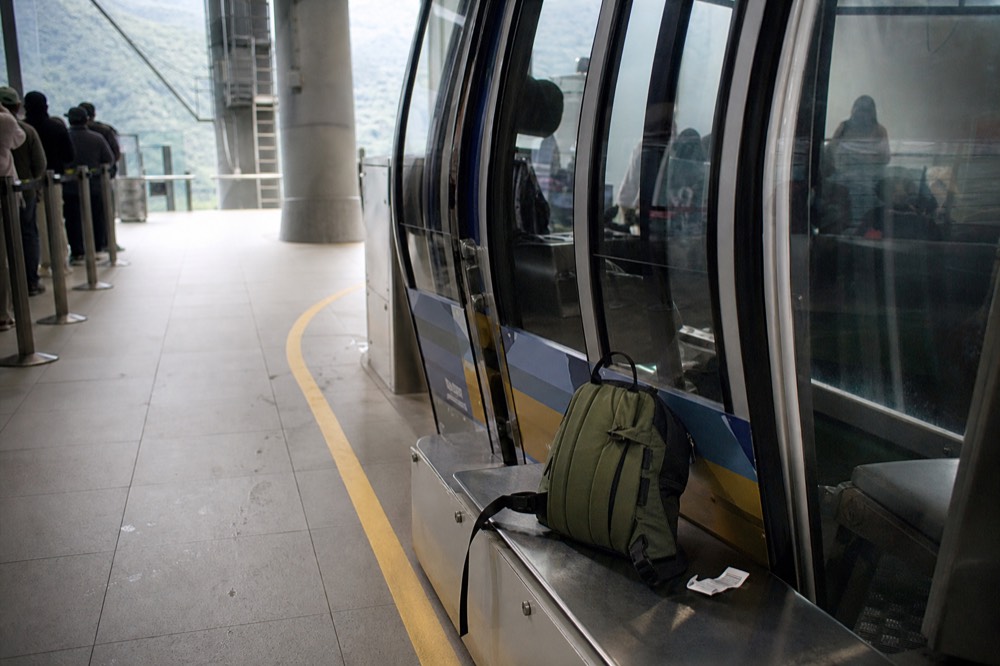
A bylaw caps cabin luggage at 48 x 34 x 23 cm and 4 kg, the size of a small daypack rather than a roller case. Anything bigger cannot travel with you. Left luggage costs HK$100 per piece, about $13, at the Tung Chung terminal and must be collected before the cable car closes the same day. (checked September 2026)
The rule comes from the Tung Chung Cable Car Bylaw, not from a discretionary gate policy, so there is no arguing around it at the platform. The dimensions catch almost every cabin-size suitcase and plenty of backpacks, which is precisely the point: the airport is 20 minutes away and people arrive with cases. If your plan involves a stopover bag, budget the left-luggage stop into the schedule, and remember the collection deadline, because the service holds bags only until the cable car closes that day.
| Item | Rule | Source of the rule |
|---|---|---|
| Cabin luggage size | maximum 48 x 34 x 23 cm | Tung Chung Cable Car Bylaw |
| Cabin luggage weight | maximum 4 kg | Tung Chung Cable Car Bylaw |
| Left luggage price | HK$100 per piece, about $13 (checked September 2026) | Operator tariff |
| Left luggage locations | Tung Chung terminal and Holidays 360 Information Centre, Ngong Ping | Operator information |
| Collection deadline | before the cable car closes the same day | Operator information |
| Food and drink in the cabin | only water may be consumed | Operator rules |
Two adjacent rules are worth knowing before you pack snacks for the plateau. Smoking is prohibited at both terminals and inside cabins under the same bylaw, and only water may be consumed on board. Neither will ruin a trip, but both are enforced at the gate, and the queue you waited in does not care that you have to throw a sandwich away.
There is also a security angle unique to this terminal. Since 29 May 2026 the operator refuses boarding to anyone holding a ticket bought from an unauthorised street tout, a response to people in staff-lookalike uniforms near Tung Chung selling tickets that had already been used. Buy from the official website, the terminal ticket office or a reputable reseller, and keep the booking in your own name, because the ticket terms allow staff to ask for ID.
How do you get from the airport to the Tung Chung cable car terminal?
The airport and the cable car share the north shore of Lantau, so the transfer is short. The E-route airport buses stop at Shun Tung Road, a 10 to 15 minute walk from the terminal, and a taxi covers the same hop in minutes. There is no direct rail link, and MTR open data publishes no airport-to-Tung Chung fare.
That last point deserves plain language, because plenty of guides invent a rail fare here. The MTR's open fare data covers journeys between stations such as Hong Kong Station to Tung Chung, which costs HK$24.30 (checked September 2026) by Octopus and takes about 30 minutes, but the airport itself sits on the Airport Express line, and no airport-to-Tung Chung fare exists in the published data. Check the MTR journey planner for the current combination rather than trusting a number a blog made up. In practice the bus or a taxi is simpler from the airport anyway, and the walk from Shun Tung Road passes through the covered walkways around Citygate Outlets.
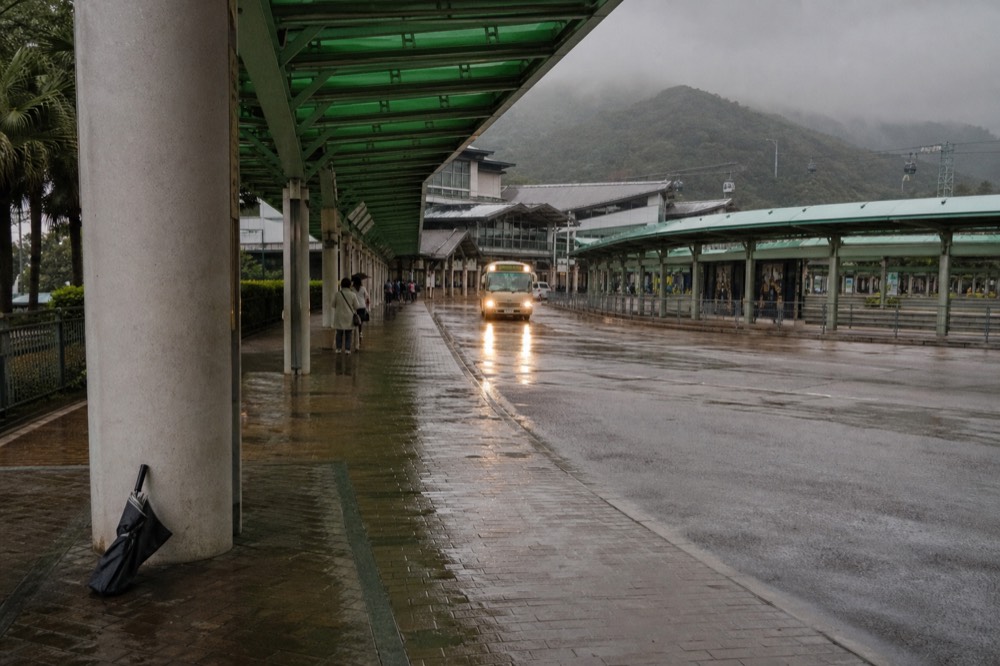
The terminal itself is easy to read once you arrive. The ticket office sits on the first floor, the boarding platforms sit above that, and the whole complex is a five-minute walk from MTR Tung Chung Exit B if you arrive by train from the city instead. Disabled visitors are escorted to the lift at Mei Tung Street up to the ticket office level, and there are two disabled parking spaces at the terminal, first come first served. Our Tung Chung terminal and transport guide covers the district in more depth if your layover includes time to spare at the Citygate outlets.
Timing note: the cable car runs 10:00 to 18:00 on weekdays and 09:00 to 18:30 on Saturdays, Sundays and public holidays, and the monastery at the top opens at 09:00, before the weekday cable car does (checked September 2026). The operator publishes no last-boarding time for normal days, so do not build your return leg around a figure someone quoted you; the only published last-boarding figure belongs to a date-limited 2026 night event and does not generalise.
One more reason to sort the ticket before you leave the airport: the plain cable car e-ticket needs no physical redemption. You present the QR code at the turnstile and walk past the counter entirely, which matters when the ticket line alone has been reported at 90 minutes.
How long is the cable car ride, and what does a ticket cost?
The ride covers 5.7 km, Asia's longest bi-cable ropeway, and takes about 25 minutes each way in a continuously moving cabin. An adult round trip costs HK$295, about $38, in a Standard cabin or HK$365, about $47, in a glass-floor Crystal cabin, with single trips at HK$205 and HK$240 (checked September 2026).
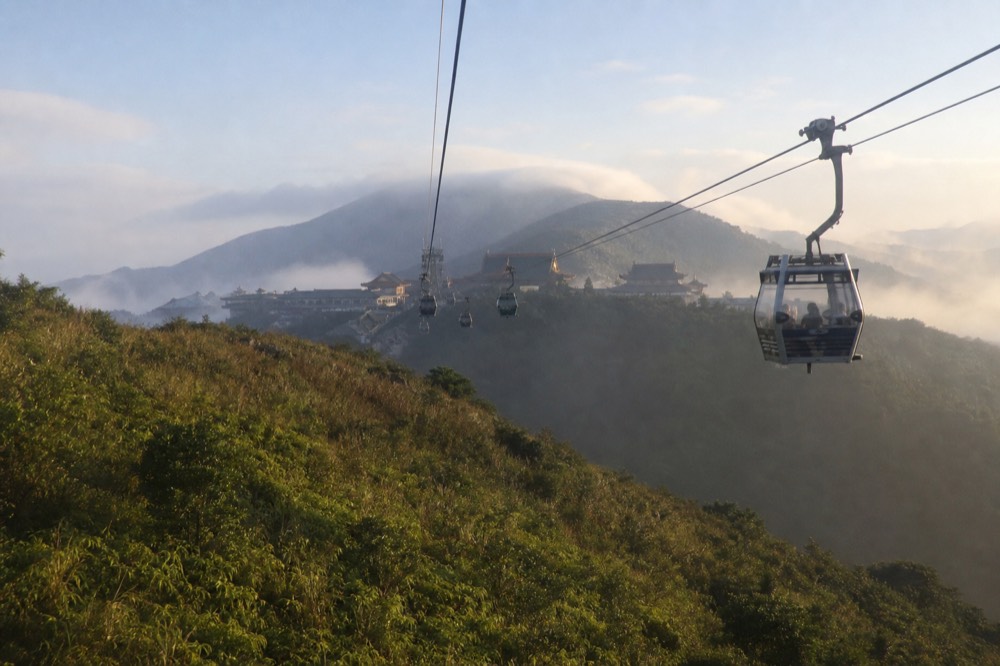
The route is the attraction as much as the destination. Cabins leave Tung Chung, cross Tung Chung Bay, swing a full 60 degrees at the Airport Island Angle Station, pass over the Hong Kong–Zhuhai–Macau Bridge, then climb through Lantau North Country Park past Nei Lak Shan before the Buddha appears and Ngong Ping Village arrives. Passengers cannot board or alight at either angle station, so there is no shortcut down mid-ride. The fleet runs 108 cabins, and the system's average reliability is 99.96 per cent, which the operator glosses as less than a minute of delay for every eight hours of operation.
| Product | Adult HKD | Adult approx USD | Child 3-11 |
|---|---|---|---|
| Round trip, Standard Cabin | HK$295 | about $38 | HK$150 |
| Round trip, Crystal Cabin | HK$365 | about $47 | HK$220 |
| Round trip, Crystal+ | HK$545 (checked September 2026) | about $70 | HK$400 |
| Combo: Crystal one way, Standard the other | HK$330 | about $42 | HK$185 |
| Single trip, Standard Cabin | HK$205 (checked September 2026) | about $26 | HK$100 |
| Single trip, Crystal Cabin | HK$240 | about $31 | HK$135 |
Prices above are the operator's official gate fares checked September 2026; infants aged 0 to 2 travel free, and children under 12 must ride with someone aged 15 or over. A resold version of the same ride starts at $21.15 on the live listing with a 4.7 rating across 61,490 reviews (checked September 2026), and the standard tiers there allow free cancellation before redemption, which is worth having when a typhoon signal can rewrite your afternoon.
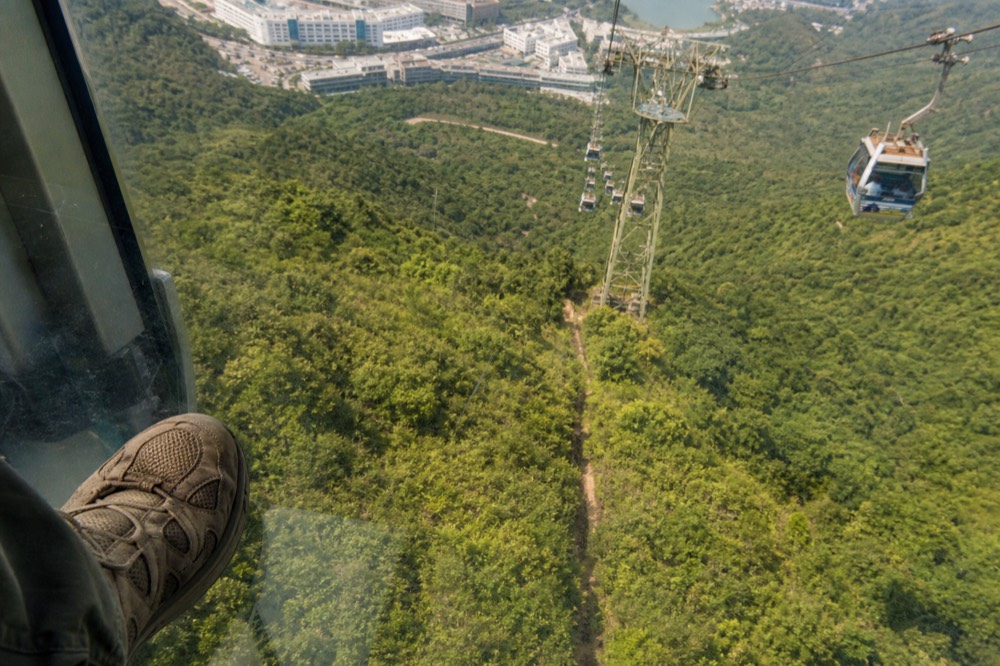
The Crystal premium is as much a queue product as a view product. Crystal and Crystal+ cabins board through their own line, reviewers report roughly ten minutes against an hour or more for Standard, and the operator itself calls the Crystal Cabin's popularity extraordinary and refuses on-the-day upgrades because of it. The glass floor is three layers of tempered glass about 4.84 cm thick, so the engineering is not the worry; the choice is whether you want the airport and the terrain under your feet or beside your face. Our Crystal versus Standard cabin comparison works through the trade in detail.
How much time do you need at the Big Buddha and Ngong Ping?
The Buddha is a 10-minute walk from the cable car terminal and the 268 steps up to it are free to climb; allow 30 to 45 minutes for the statue itself. Po Lin Monastery opens 09:00 to 18:00 and its vegetarian kitchen serves 11:30 to 16:30, so a midday arrival eats well (checked September 2026).
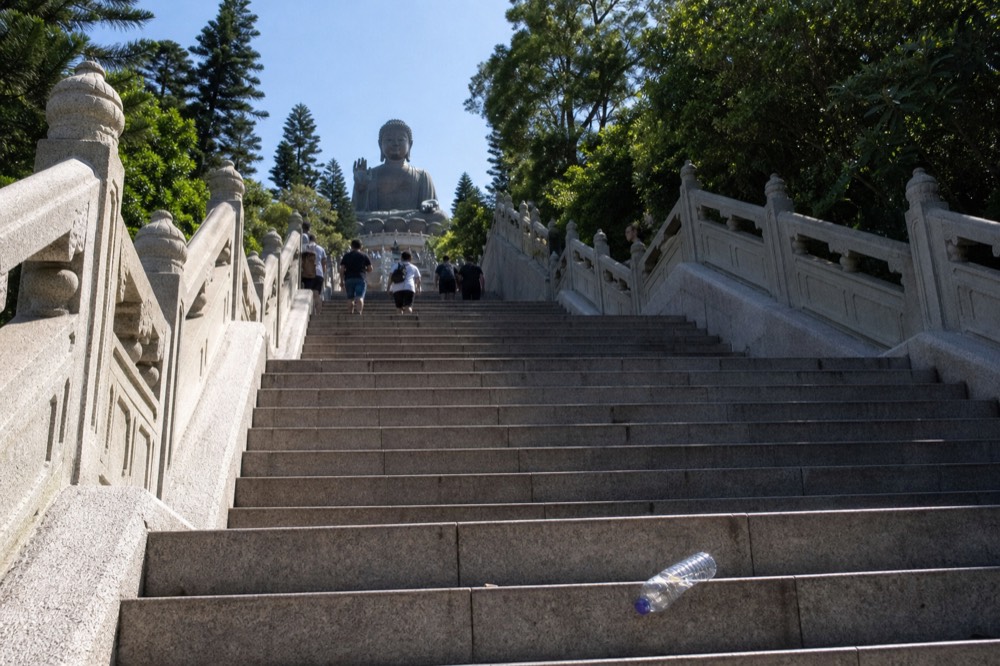
The climb is the easy part. Two hundred and sixty-eight steps sounds worse than it is, most visitors manage them in ten to fifteen minutes with photo stops, and nothing at the statue itself charges admission. The engineering is worth a moment at the top: the face was cast as a single five-tonne piece, 4.3 by 5.8 metres, and the whole 250-tonne statue was wind-tunnel tested in the Beijing facility built for satellites and rockets before the final bronze piece went up in October 1989.
Food planning is where layover visitors get caught. The monastery's vegetarian kitchen serves a fixed communal set, generally a soup, a deep-fried dish and a vegetable dish with rice, but the monastery publishes no price on its own site, so check at the door rather than budgeting from a number you read online. The kitchen's 11:30 to 16:30 window is firm, and there is a snack shop next door whose bean curd dessert and mango glutinous rice dumplings the monastery itself singles out, the dumplings made in small quantities only.
One correction that matters for 2026: the Wisdom Path, the 38 timber columns carrying the Heart Sutra in a figure-of-eight below Lantau Peak, has been closed since 5 June 2025 for refurbishment, with completion due in the last quarter of 2026. Most older guides still list it as an open, free attraction. It is not, and a viewing platform on a nearby Lantau Trail section is the only part you can currently see (see Lantau and China). Skip it, and spend the time at the Big Buddha and monastery complex instead.
If your layover runs long enough to add Tai O, the stilt-house fishing village is a 20-minute bus ride from Ngong Ping on route 21, and a 20-minute boat excursion runs from the village's iron footbridge. That extension pushes the realistic budget past eight hours, which is where a guided day product starts to earn its premium:
What if the cable car is closed or suspended?
The cable car closes for scheduled maintenance several times a year, including 8 to 18 September 2026, and suspends in typhoon and storm conditions. New Lantao Bus 23 runs the same journey from Tung Chung for HK$20.40 on a weekday, HK$37.00 on Sundays and holidays, so the plateau stays reachable (checked September 2026).
The maintenance pattern surprises people who assume a ropeway shuts once a year. One long overhaul of ten to twenty days, in March or September, plus three or four shorter closures, is the established rhythm, and 2026 has already seen closures in January, March, May, June and the September overhaul. Ngong Ping Village and its indoor attractions, including the Cable Car Discovery Centre, stay open throughout, so a closure kills the ride, not the destination.
| 2026 cable car closure | Status |
|---|---|
| January closure | service resumed 23 January 2026 |
| 3 to 5 March 2026 | full closure |
| May closure | service resumed 21 May 2026 |
| June closure | service resumed 22 June 2026 |
| 8 to 18 September 2026 | the long annual overhaul |
Nothing is announced for 2027 yet, so a layover early next year carries genuine uncertainty, and the live check is the operator's own visitor information page or the guest services hotline. Weather suspensions follow the same logic. The operator's current wording says the service may be suspended in rainstorm or thunderstorm conditions depending on circumstances, and the only primary source with numeric wind thresholds is a 2006 Legislative Council reply: suspension designed at 90 km/h persistent wind or 135 km/h gusts, with persistent defined as a 30-second average. Observatory data collected at Ngong Ping found those conditions existed inside operating hours on an average of seven days a year. Those are design figures from 2006, not current published policy, and the operator publishes no wind number today, so treat them as background rather than a rule.
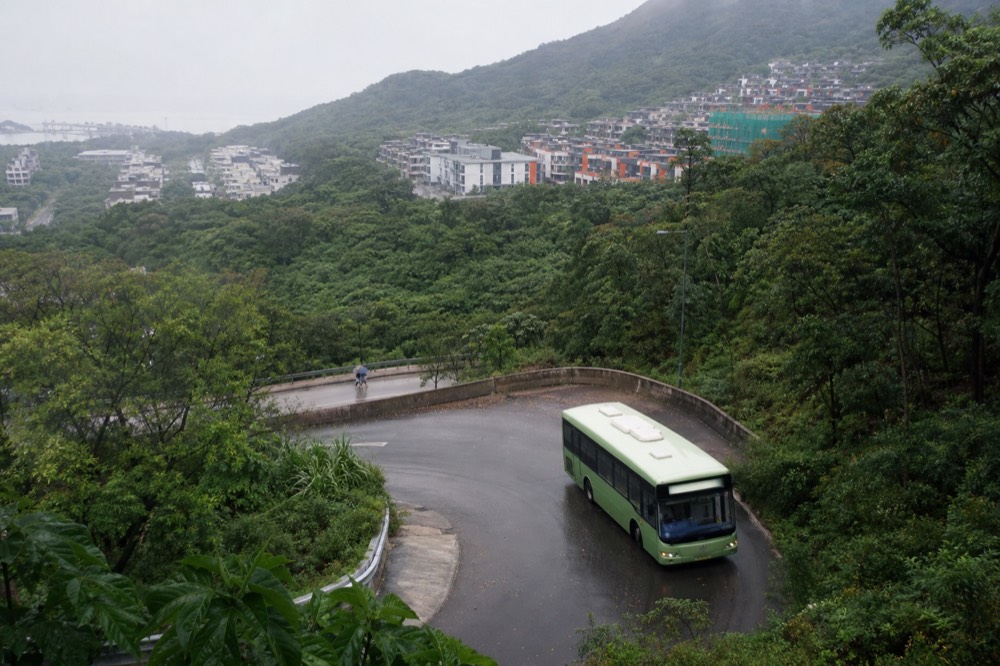
The bus fallback has one trap. Route 23 costs HK$20.40 (checked September 2026) on a normal day and HK$37.00 on a Sunday or public holiday, an 81 per cent jump on exactly the days a visitor is most likely to need it, and it climbs the winding Tung Chung Road, which is rough on motion-sensitive passengers. Route 21 from Ngong Ping to Tai O and route 11 from Tung Chung to Tai O follow the same weekday-versus-holiday fare structure. Journey times and frequencies for these routes are not in the official open data, so check the operator's own channels rather than a timetable a blog invented.
| New Lantao Bus route | Weekday fare | Sunday and holiday fare |
|---|---|---|
| 23: Tung Chung Tat Tung Road to Ngong Ping | HK$20.40 (checked September 2026) | HK$37.00 (checked September 2026) |
| 21: Ngong Ping to Tai O | HK$7.90 (checked September 2026) | HK$19.20 (checked September 2026) |
| 11: Tung Chung Station to Tai O | HK$14.00 (checked September 2026) | HK$23.30 (checked September 2026) |
If a suspension catches you with a ticket already bought, the terms allow an exchange for another date or a refund at either terminal's ticket office or by email to the operator, with one exception: annual pass holders get no refund for weather or technical suspension.
When is the worst time to attempt this trip?
Avoid February to April for visibility and August to early October for storm risk. Hong Kong averages just 3.7 fog days a year and 3.40 of them fall in those three months, while tropical cyclone signals peak in August at 4.17 days. October and November are the statistical sweet spot.
The fog fact is the counterintuitive one. Most people assume a summer ride risks a whiteout, but the Observatory's 1991 to 2020 normals show the visibility problem is a late-winter and spring phenomenon: February and March also post the year's lowest sunshine hours and highest humidity, which is exactly the low-cloud regime the Ngong Ping plateau sits in. A foggy ride is not refunded as a matter of policy, so in those months the early-morning gamble is the wrong one; the plateau often clears later in the day.
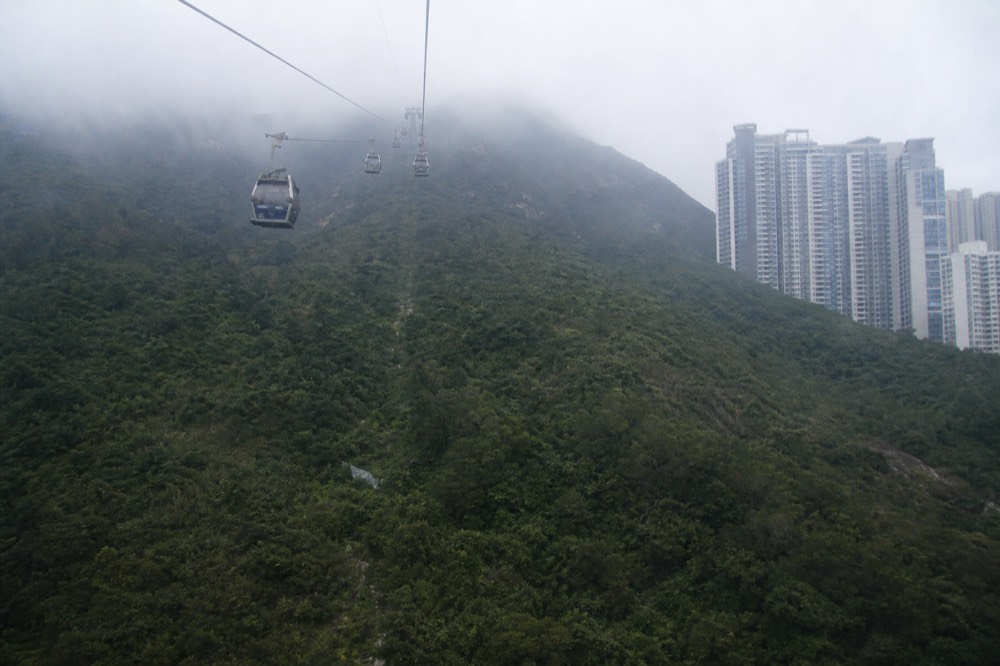
The storm season runs the other way. Cyclone warning signals average 15.87 days a year, concentrated June to October and peaking in August, and June to August is also the wettest stretch by a wide margin. One caveat belongs here: these are Observatory headquarters figures recorded near sea level in the city, and Ngong Ping sits high on Lantau, cooler, wetter and cloudier than the urban station. Use the city numbers for season-shape, not for what the plateau will feel like at 11am.
Crowds follow the calendar more than the weather. The operator opened weekend hours earlier than weekday hours precisely because weekends run busier, its own figures show Crystal+ cabins above 90 per cent utilisation during summer, Golden Week and Christmas, and it recorded record Mainland visitor days during the National Day holiday. Mainland Golden Weeks fall 1 to 5 May and 1 to 7 October in 2026, and Hong Kong's own gazetted holidays cluster around Lunar New Year in February, Easter in April, and 1 October. A weekday outside those windows, in October or November, is the version of this trip that works.
Is a guided tour a better fit for a short layover?
A guided tour trades flexibility for certainty: someone else watches the clock, the transport and often the queue. The roster runs from a $45.92 private-coach day to a $100.76 VIP priority-boarding tour, against $21.15 for the bare ticket, so the premium buys logistics rather than a better view (checked September 2026).
The bare ticket is the right call for a long layover and a confident traveller: the transfer is short, the plateau is walkable, and the only real skill required is buying the e-ticket ahead and choosing a cabin tier that matches your queue tolerance. Where a tour earns its margin is the compressed schedule. A five-hour guided product bundles the cable car, the Buddha and Tai O into a fixed window, and the VIP variant adds priority boarding, which on a bad Standard day is worth more than the sightseeing itself.
The budget end deserves a look too. The $45.92 private-coach option carries a 4.8 rating from a smaller pool of 61 reviews, while the VIP tour runs 4.5 across 362 and the five-hour Tai O tour 4.7 across 652 (all checked September 2026). Review depth matters more than the decimal here: the smaller pools swing with a handful of strong or weak days. What none of them can fix is a closure, so the maintenance calendar check comes before any booking, guided or not.
For travellers who want the priority treatment without the full seven-hour commitment, the middle of the roster holds the answer, and the private-coach version below is the one that fits tight schedules at the lowest price:
Whichever way you book, keep the cancellation terms in view. Standard-tier tickets on the live listing allow free cancellation before redemption, and the operator's own weather policy permits date exchange or refund at the ticket office, so the money risk on this trip is small. The real risk is time, and no tour operator refunds that.
If the layover plan holds together, the three products below cover the spread from bare ticket to full VIP day:
The six questions below cover the decisions that make or break an airport layover visit: the minimum realistic layover length, the total cost, the luggage bylaw, the bus fallback during closures, the climb itself and what happens to your money if weather suspends the ride. Each answer states only figures from the operator's published fares and terms.
Common questions about getting from Hong Kong airport to the Big Buddha
Can you visit the Big Buddha on a Hong Kong airport layover?
Yes, on a layover of roughly six hours or more. The cable car terminal is about 20 minutes from the airport, the ride takes 25 minutes each way, and the climb is free. The binding constraint is the boarding queue, which visitors report at one to three hours for Standard cabins, so shorter layovers are a gamble.
How much does it cost to get from Hong Kong airport to the Big Buddha?
The cable car is the main cost: an adult round trip is HK$295, about $38, in a Standard cabin or HK$365, about $47, in a Crystal cabin (checked September 2026). Climbing the Buddha's 268 steps is free, and a resold standard ticket starts at $21.15 on the live listing.
Can I take my luggage on the cable car?
Only if it measures under 48 x 34 x 23 cm and weighs under 4 kg, under the Tung Chung Cable Car Bylaw. Larger bags cannot travel. Left luggage costs HK$100 (checked September 2026) per piece at the Tung Chung terminal and must be collected before the cable car closes the same day.
What happens if the cable car is closed for maintenance?
New Lantao Bus 23 runs from Tung Chung Tat Tung Road to Ngong Ping for HK$20.40 on a weekday and HK$37.00 on Sundays and public holidays (checked September 2026). Ngong Ping Village and its indoor attractions stay open during cable car closures, so the Buddha itself remains reachable.
How many steps does the Big Buddha have?
There are 268 steps from the plaza up to the statue, a figure verified on the Hong Kong Tourism Board's own page. The climb is free and most visitors manage it in ten to fifteen minutes with photo stops.
Is the cable car ticket refundable if weather suspends the ride?
Holders of tickets can exchange for another date or claim a refund at either terminal's ticket office or by emailing the operator, with annual pass holders the one exception. The operator publishes no numeric wind threshold on its current site; the 90 km/h persistent and 135 km/h gust figures come from a 2006 Legislative Council reply describing the system's design.