Is the Big Buddha in Hong Kong Worth Seeing?
An honest verdict on the Tian Tan Buddha: the free 268-step climb, the real cost of getting there, current fares and closures, and what the bronze statue actually is.
Is the Big Buddha in Hong Kong Worth Seeing?
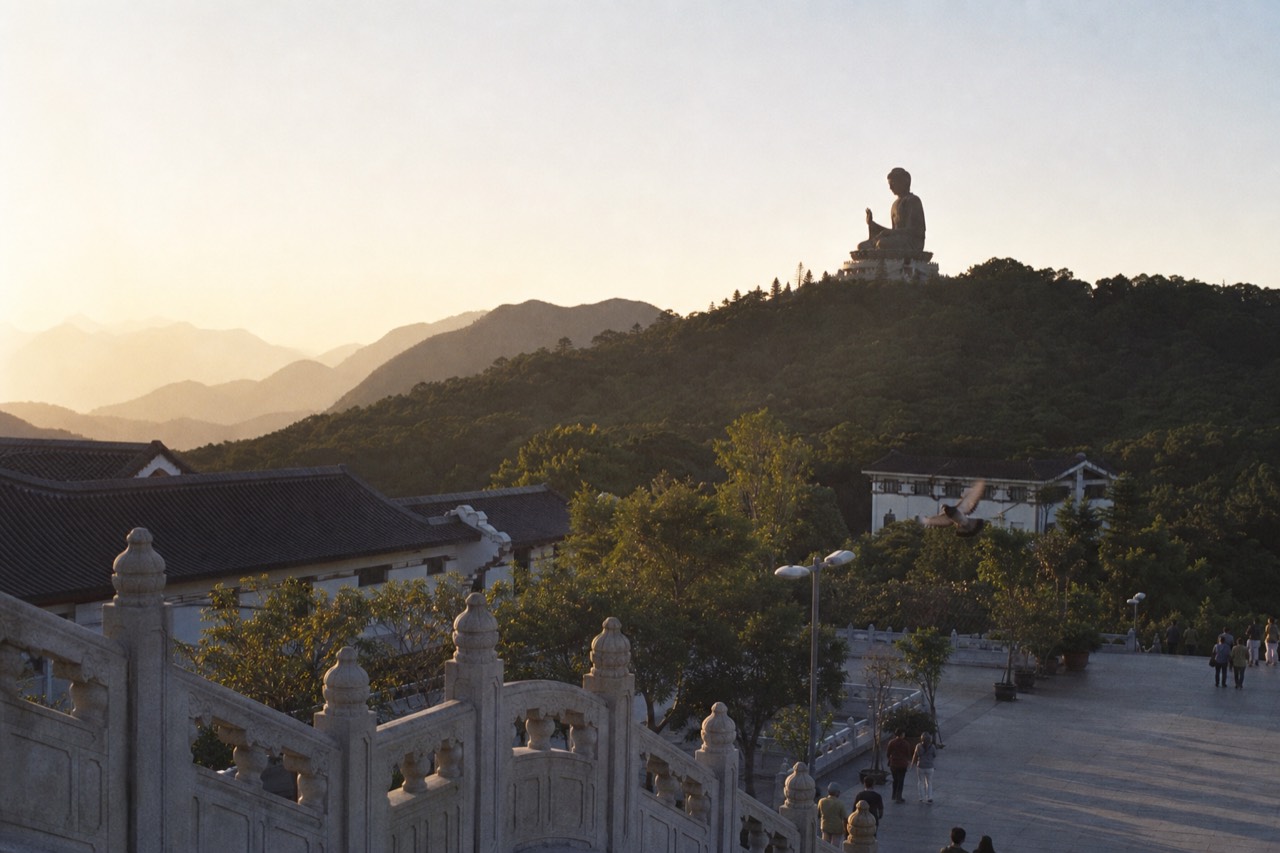
Yes, for most visitors the Big Buddha is worth seeing: the 34-metre bronze statue is free to climb, sits on one of the most dramatic hilltop sites in Hong Kong, and the 268-step approach is a genuine experience rather than a photo stop. The honest caveat is that the statue itself is a short visit, and most of the day's cost and effort go into the journey rather than the sight.
The statue, formally the Tian Tan Buddha, is a seated bronze figure on Mount Muk Yue at the edge of the Ngong Ping plateau, facing north towards Beijing. It was inaugurated on 29 December 1993 after twelve years of construction and roughly 250 tonnes of bronze. Po Lin Monastery stands immediately beside it, and the whole complex sits 10 minutes on foot from the Ngong Ping cable car terminal, high enough that the plateau is often a few degrees cooler and considerably cloudier than the city below.
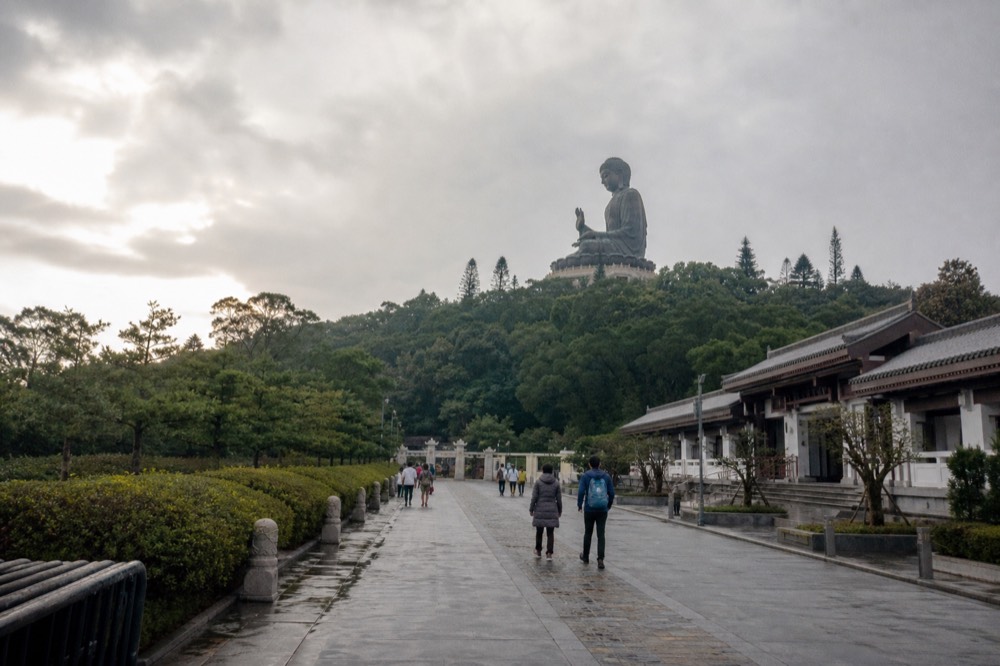
What makes it worth the trip is the combination. The climb is free, the statue is enormous and close enough to touch at the top, and the colonnade around its base looks out over Lantau's western hills, the airport and the sea. Very few major sights in Hong Kong cost nothing and deliver this much scale. The complete guide to the Big Buddha on this site covers the statue in depth for readers who want the full picture.
The counterpoint matters just as much. The cable car round trip costs more than everything at the top combined, queues for standard cabins have run to one or more hours in recent visitor reports, and the plateau's weather can erase the views entirely in the wrong season. Whether the day feels worth it depends less on the statue, which reliably delivers, and more on how you get up the mountain and when. The three options below are the ones most visitors actually compare.
What does seeing the Big Buddha actually cost?
Seeing the Big Buddha itself is completely free: the 268 steps and the plaza carry no entrance fee, ticket, or time slot. Your money goes on getting there. A round-trip Standard Cabin cable car ticket costs HK$295 (about $38, checked September 2026), New Lantao Bus 23 is HK$20.40 on a weekday (about $2.60), and the MTR from Hong Kong Station to Tung Chung is HK$24.30 by Octopus (about $3.10).
That asymmetry is the single most useful thing to know about the visit. The attraction is free; the access is not. Climbing the steps costs nothing at any hour the site is open, and the plaza around the base is open to walk around at no charge. Everything in the table below is transport or optional extras, and all figures are current operator rates (checked September 2026).
| Item | Price | What you get |
|---|---|---|
| Climb to the Big Buddha | Free | 268 steps, plaza and exterior colonnade |
| Cable car, Standard round trip | HK$295, about $38 | 5.7 km ride each way, about 25 minutes per leg |
| Cable car, Crystal round trip | HK$365, (checked September 2026) about $47 | Glass-floor cabin, shorter boarding line |
| Cable car, Standard single trip | HK$205, about $26 | One way up, bus or cable car back |
| New Lantao Bus 23 | HK$20.40 (checked September 2026) weekday, HK$37.00 Sunday or holiday | Road route from Tung Chung to Ngong Ping |
| MTR, Hong Kong Station to Tung Chung | HK$24.30 Octopus, HK$28.00 (checked September 2026) single ticket | About 30 minutes on the Tung Chung Line |
| Left luggage at the terminal | HK$100 a piece | Bags over 48 x 34 x 23 cm or 4 kg cannot ride the cabins |
Two details in that table deserve attention. The Sunday and holiday bus fare is 81 percent higher than the weekday fare, so the cheap fallback route nearly doubles in price on exactly the days most people visit. And the luggage rule is a genuine trap for airport stopovers: anything over 48 x 34 x 23 cm or 4 kg is barred from the cabins by the Tung Chung Cable Car Bylaw, which is why the terminal runs a left-luggage desk at HK$100 a piece.
For the cable car itself, a pre-booked e-ticket from the operator's live listing starts at $21.15 (checked September 2026), well below the walk-up round-trip gate price, and plain cable car e-tickets scan directly at the turnstile with no counter stop. The product carries a 4.7 rating from 61,490 reviews (checked September 2026) and covers the roughly 25-minute ride each way. It is the default way up for most independent visitors, and the one this site recommends starting with.
How do you get to the Big Buddha?
The standard route is the MTR Tung Chung Line from Hong Kong Station to Tung Chung, about 30 minutes, then a five-minute walk from Exit B to the cable car terminal, then the 5.7 km, roughly 25-minute ride to Ngong Ping. The cheaper alternative is New Lantao Bus 23 from Tat Tung Road beside the terminal, which costs HK$20.40 on a weekday and HK$37.00 on Sundays and public holidays (checked September 2026).
The cable car is the reason most people make the trip at all. The line is the longest bi-cable ropeway in Asia, runs a fleet of 108 cabins, and turns a full 60 degrees at the Airport Island angle station, crossing Tung Chung Bay, the airport, the Hong Kong-Zhuhai-Macau Bridge and the country park before arriving at the plateau. Ngong Ping 360 Limited is a subsidiary of the MTR Corporation, so the metro that carries you to the base terminal belongs to the same company operating the cable car above it. The ride, the cabins and the fare tiers are tracked across Hong Kong Ngong Ping Cable Car, this site's main subject, in far more detail than a verdict piece can hold.
The budget route is the bus. Route 23 departs from Tat Tung Road Bus Terminus, beside the cable car terminal and Citygate Outlets, and climbs the winding Tung Chung Road over the mountain to Ngong Ping. It costs a fraction of the cable car, it runs when the cable car does not, and it is the standard fallback during maintenance closures and weather suspensions. The trade-off is the road itself: it is narrow and winding, and motion-sick passengers are a known feature of the route.
| Option | Journey time | Adult fare | Notes |
|---|---|---|---|
| MTR Tung Chung Line, Hong Kong Station to Tung Chung | About 30 minutes | HK$24.30 Octopus, HK$28.00 (checked September 2026) single ticket | Then a 5-minute walk from Exit B |
| Cable car, Tung Chung to Ngong Ping | About 25 minutes each way | HK$295 Standard round trip, HK$365 (checked September 2026) Crystal | 5.7 km, 108 cabins, glass-floor option |
| New Lantao Bus 23, Tung Chung to Ngong Ping | Not published by the operator | HK$20.40 weekday, HK$37.00 (checked September 2026) Sunday or holiday | Winding road route over the mountain |
| New Lantao Bus 21, Ngong Ping to Tai O | About 20 minutes | HK$7.90 weekday, HK$19.20 (checked September 2026) Sunday or holiday | Onward to the stilt-house village |
Hours matter as much as route. The cable car and village run 10:00 to 18:00 on weekdays and 09:00 to 18:30 on Saturdays, Sundays and public holidays (checked September 2026), per the operator's tourist guide page. Po Lin Monastery opens at 09:00, before the cable car does on a weekday, which is only useful if you come up by bus. If the queue reports or the fare ladder have you weighing cabin types, the Crystal Cabin versus Standard Cabin comparison breaks down the glass-floor premium.
What is the climb to the Big Buddha like?
From the plaza, 268 steps climb to the base of the statue, and the climb is free. The steps are wide, stone and steady rather than alpine, but there is no shade on the upper flights and no lift to the top. The colonnade at the top circles the statue and looks out across Lantau, the airport and the South China Sea on clear days.
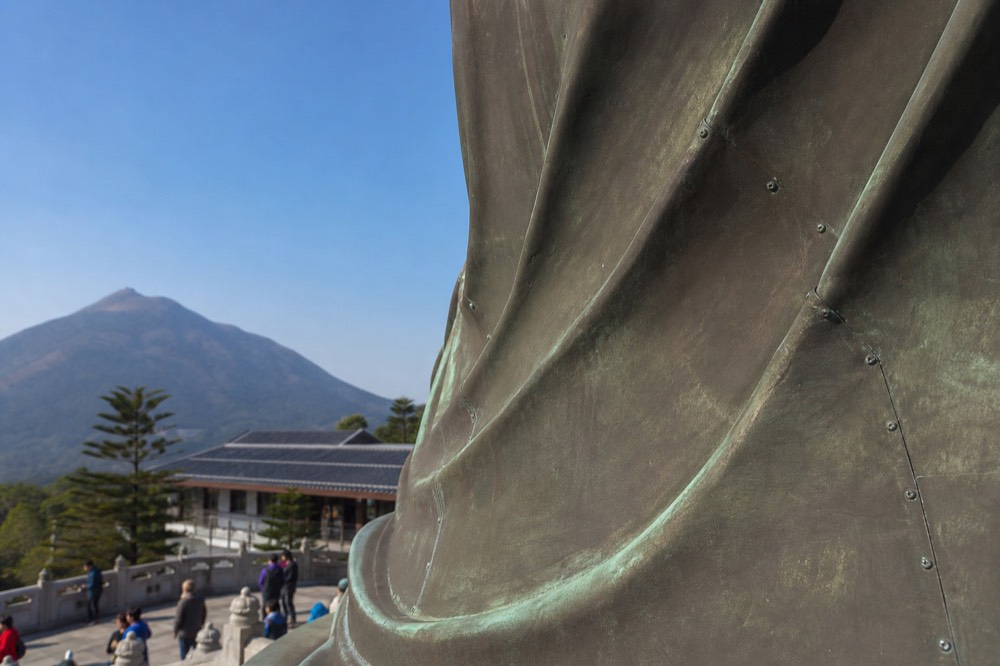
The step count is not folklore. The Hong Kong Tourism Board's own page states plainly that visitors must ascend 268 steps to reach the statue, and the figure checks out against every official source this site reviewed. The staircase is broad enough for two-way traffic, the risers are even, and the landing at the top rewards you with the statue at arm's length: close enough to see the individual bronze panels and the casting seams of the robe.
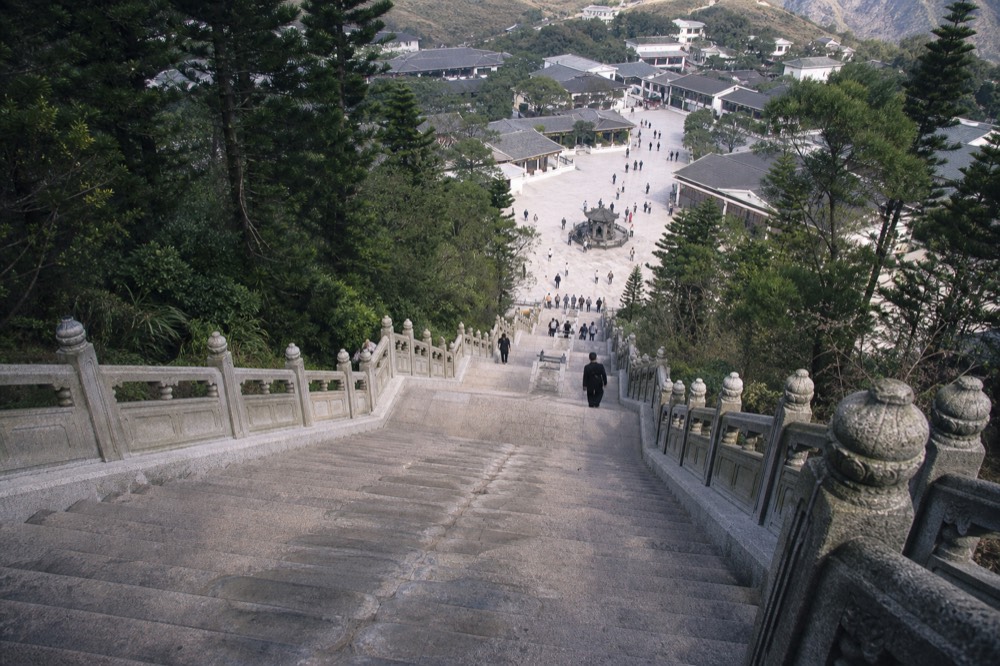
A few honest notes for planning. The steps are the only published way up to the colonnade, so anyone who cannot manage them can still see the statue well from the plaza and the monastery approach, but the base itself is out of reach. Water is worth carrying, since the flights are exposed and the plateau sits high enough that midday sun lands hard even in cooler months. This site keeps a dedicated answer on how many steps the Big Buddha has, including where to rest and what the plaza offers.
The reward at the top is twofold. The statue's right hand is raised in the mudra of imparting fearlessness, the left rests on its lap fulfilling wishes, and the six bronze mothers beside the base each hold a different offering. Then there is the view: a full circle over the plateau, the monastery rooflines below, and, on the clear October and November days, the airport runway and the bridge to the west.
What is the statue actually made of?
The Tian Tan Buddha is a 34-metre bronze statue, 26.4 metres of body above the lotus throne, cast from 202 separate bronze sections and roughly 250 tonnes of metal, built over twelve years and inaugurated on 29 December 1993. Its face is a single casting, 4.3 by 5.8 metres and five tonnes, and the whole statue was wind-tunnel tested in the Beijing facility built for satellites and rockets.
This is the part of the story that most visitors never hear, and it is the strongest argument that the statue is more than a big photo. According to Po Lin Monastery's own construction record, the 202 bronze sections were cast 10 to 13 mm thick, to a tolerance of under 3 mm, at a plant in Nanjing. The face alone, one single 5-tonne piece, had to be carried up Lantau's narrow roads on a lorry sandwiched between two cranes. The plaster model that preceded it took two years and eight redrafts.
The engineering detail is the one worth retelling. Before a single bronze panel was cast, the design was wind-tunnel tested by the Beijing Institute of Aerodynamics using the wind tunnel built for satellites and rockets, tested both directionally and multidirectionally, on the whole statue and on its parts. A hilltop statue on an exposed plateau has to stand in typhoon-country winds for a century, and it was treated like aerospace hardware before it was treated like art. The face was modelled on the Vairocana Buddha of the Longmen Caves, the robes on a Sakyamuni at Dunhuang, and the name Tian Tan comes from the base platform, modelled on Beijing's Altar of Heaven.
None of this changes what you see, but it changes what you are looking at. The statue is not ancient, and it is not accidental: it is a deliberately engineered modern landmark that a monastery spent twelve years and a government land grant to build. Knowing that, the climb reads differently.
When is the best time to see the Big Buddha?
October and November are the statistical sweet spot: the year's lowest humidity, no recorded fog days, high sunshine and a fading typhoon risk. Fog is a February-to-April problem, accounting for 3.40 of Hong Kong's 3.70 annual fog days, while tropical cyclone signals peak in August at 4.17 days a month. The cable car also closes 8 to 18 September 2026 for its annual maintenance overhaul.
The weather here is not one risk but two, and they sit in different seasons. The visibility problem is a late-winter and spring problem: Hong Kong averages just 3.7 fog days a year, and nearly all of them fall in February, March and April, the same months with the year's lowest sunshine and highest humidity. The plateau sits high and catches low cloud first, so a blue-sky morning in Central can be a whiteout at Ngong Ping. The wind problem is a summer problem: cyclone warning signals concentrate from June to October, peaking in August.
| Period | Visibility | Cyclone signal days | Verdict for the climb |
|---|---|---|---|
| February to April | Fog season: 3.40 of the year's 3.70 fog days | Near zero | Views at real risk of whiteout |
| May to August | Haze, heaviest rain of the year | Rising to 4.17 days in August | Ride may suspend; climb still possible |
| September | Improving | 3.83 days | Cable car shut 8 to 18 September 2026 |
| October to November | No recorded fog days, lowest humidity | Falling, 1.70 in October | The best window of the year |
The closure calendar deserves a paragraph of its own, because it is the planning fact people most often miss. The cable car does not close once a year; it closes several times, with short 2026 shutdowns in January, March, May and June around the long annual overhaul from 8 to 18 September. Ngong Ping Village stays open throughout while the cabins are suspended. Anyone visiting in a closure window can still reach the statue by New Lantao Bus 23, and the monastery opens before the cable car does on weekdays regardless.
What else is at the top?
The statue shares the Ngong Ping plateau with Po Lin Monastery, a working monastery founded in 1906 whose grounds open 09:00 to 18:00, and Ngong Ping Village, a 1.5-hectare retail and attraction site where two indoor attractions can be added for HK$20 each with any cable car ticket (checked September 2026). One warning: the Wisdom Path, which most guides still list as open, has been closed since 5 June 2025 for refurbishment.
Po Lin Monastery is not a photo backdrop; it is the institution that built the Buddha, officially named in 1924 on a site formerly called the Big Thatched Hut. Its grounds are free to walk, its vegetarian kitchen serves a fixed communal set lunch from 11:30 to 16:30 daily (checked September 2026), though the monastery publishes no meal price, so treat any figure you see elsewhere as a report rather than a rate. The souvenir shop sits in the Hall of Merits on the first floor of the Buddha's base platform.
The Wisdom Path correction matters enough to state twice on one page. The 38 timber columns inscribed with the Heart Sutra, arranged in a figure-of-eight below Lantau Peak, have been fenced off since 5 June 2025, with the Tourism Commission expecting refurbishment to finish in the last quarter of 2026 and reopening to happen in stages. A viewing platform on a nearby section of the Lantau Trail stays open. Any itinerary that lists the Wisdom Path as a stop in 2026 was written before the closure.
| Sight at the top | Status | Cost |
|---|---|---|
| Big Buddha steps, plaza and colonnade | Open | Free |
| Po Lin Monastery grounds | Open 09:00 to 18:00 | Free |
| Vegetarian kitchen | Serves 11:30 to 16:30 daily | Price not published by the monastery |
| Wisdom Path | Closed since 5 June 2025, reopening due Q4 2026 in stages | Was free |
| Cable Car Discovery Centre and Motion 360 | Open | HK$20 each (checked September 2026) via the upgrade offer with any cable car ticket |
Beyond the plateau, Tai O, Hong Kong's oldest fishing village with its stilt houses, is about 20 minutes away on New Lantao Bus 21 at HK$7.90 on a normal day and HK$19.20 on Sundays and holidays (checked September 2026). The operator recommends allowing at least three to four hours to explore the village and eat, which is why the plateau rewards a half-day rather than a quick cable-car loop.
Should you take a guided tour or go independently?
Going independently with a cable car ticket suits most visitors: the plateau is compact, the walk from the terminal to the statue is about ten minutes, and nothing at the top requires a guide. A guided tour earns its price when you want Tai O and the stilt houses folded into the same day without planning buses yourself, with options from $45.92 to $100.76 (checked September 2026).
The independent day is simple: cable car up, statue and monastery, lunch, cable car down, with the bus as your fallback in both directions. Nothing about that requires booking anything beyond the ticket, and the plateau's single walkable layout makes it hard to get lost. The guided alternatives exist for a different problem: the plateau is only half of Lantau's west coast, and reaching Tai O, the stilt houses and the boat rides on your own means matching two bus timetables to a cable car schedule.
| Option | Format | From | Rating |
|---|---|---|---|
| Cable car ticket only | Ride each way, about 25 minutes per leg | $21.15 | 4.7 from 61,490 reviews |
| Budget tour with private coach | 5-hour guided day tour | $45.92 (checked September 2026) | 4.8 from 61 reviews |
| Tai O and Big Buddha tour | 5-hour guided tour with Tai O boat ride | $67.6 | 4.7 from 652 reviews |
| Cable car, Big Buddha and fishing village | 6-hour guided tour | $70.15 (checked September 2026) | 4.8 from 490 reviews |
| VIP priority boarding tour | 7-hour guided tour | $100.76 | 4.5 from 362 reviews |
All prices and ratings above come from the operators' live listings (checked September 2026). The six-hour version is the one that consistently earns the strongest reviews, and it is the natural upgrade if the stilt houses are the part of Lantau you actually came for: it pairs the cable car with the Big Buddha and carries on to the fishing village rather than doubling back.
The budget coach tour deserves a fair hearing too. At $45.92 (checked September 2026) it undercuts every other guided option, still covers the Buddha and Tai O in five hours, and suits travelers who want the logistics handled without paying for VIP boarding. The honest ranking, after fares, queues and closures: buy the cable car ticket first, decide on a tour second, and only pay for a guided day if the fishing village is non-negotiable.
The short answers below cover the step count, the true cost, the bus alternative when the cable car is shut, the Wisdom Path closure and how long to allow on the plateau. The headline verdict stands: the statue is free and genuinely worth the climb for most visitors, while the journey is where the planning, the cost and the seasonal risk actually sit.
Common questions about the Big Buddha
Is the Big Buddha in Hong Kong Worth Seeing?
Yes, for most visitors. The climb is free, the statue is a genuinely impressive 34-metre bronze structure with a real engineering story behind it, and the plateau setting is one of the most dramatic in Hong Kong. The caveats are the cost and time of getting there, seasonal fog from February to April, and cable car queues that can run over an hour at peak times.
How many steps does the Big Buddha have?
There are 268 steps from the plaza to the base of the statue, a figure stated on the Hong Kong Tourism Board's own page. The climb is free, the staircase is wide and steady, and the colonnade at the top circles the statue with views over Lantau and the sea.
How much does it cost to see the Big Buddha?
Nothing at the statue itself: the steps, plaza and colonnade are free. The cost is transport, typically HK$295 for a Standard round-trip cable car ticket, about $38 (checked September 2026), or HK$20.40 on the weekday bus, about $2.60 (checked September 2026).
Can you visit the Big Buddha without taking the cable car?
Yes. New Lantao Bus 23 runs from Tat Tung Road beside the terminal to Ngong Ping for HK$20.40 on a weekday and HK$37.00 on Sundays and public holidays (checked September 2026). It is also the standard fallback when the cable car is closed for maintenance, as it is from 8 to 18 September 2026.
Is the Wisdom Path open?
No. The Wisdom Path has been closed since 5 June 2025 for refurbishment, with completion expected in the last quarter of 2026 and reopening in stages. A viewing platform on a nearby section of the Lantau Trail remains open, but the 38 Heart Sutra columns themselves are off limits.
How long should you spend at the Big Buddha?
The statue, plaza and monastery can be seen in a couple of hours, but the operator recommends allowing at least three to four hours to explore Ngong Ping Village and eat. Add travel time on top: the cable car ride is about 25 minutes each way, and the MTR from Hong Kong Station adds about 30 minutes before that.